

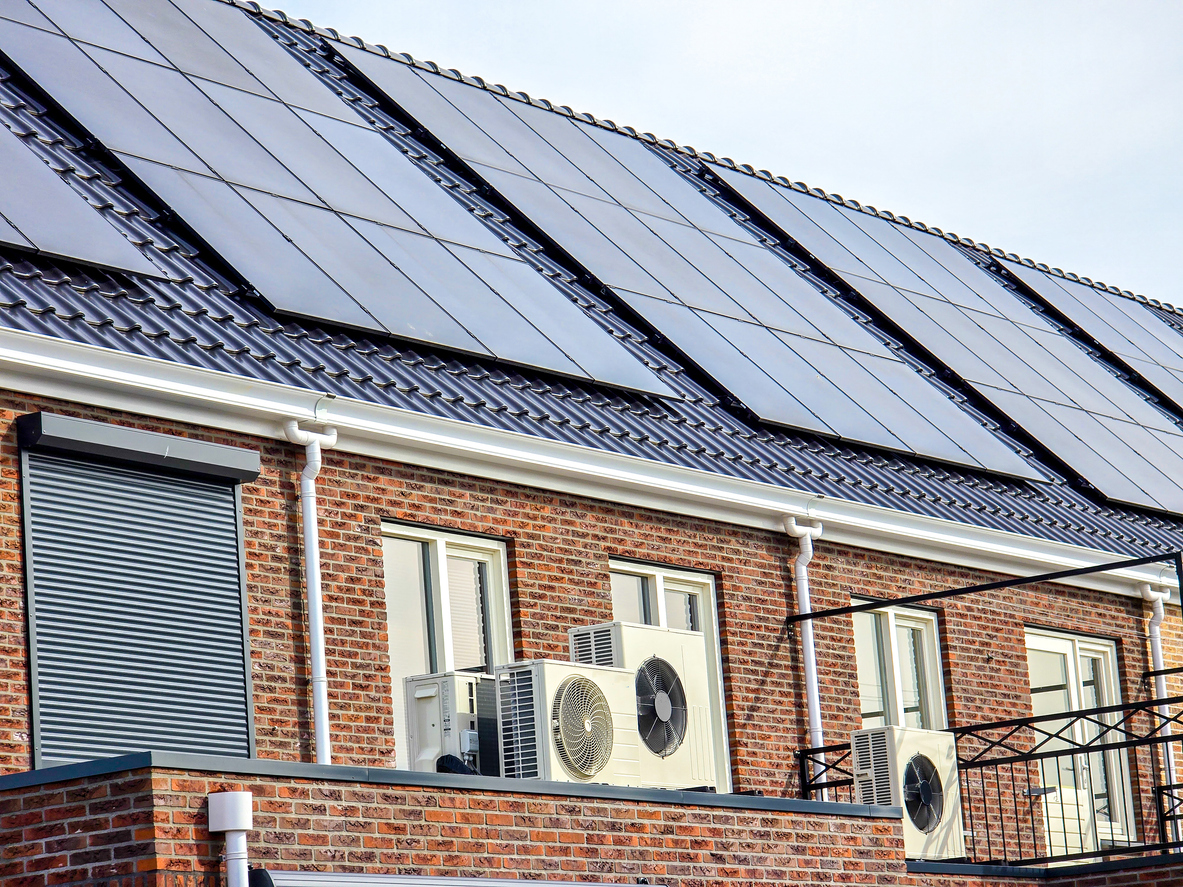
If you’ve been reading anything about decarbonising your home lately, you’ve probably been told you need roughly everything at once. Solar panels. A heat pump. A battery. Better insulation. A smart tariff. Maybe an EV while you’re at it. All of it, ideally yesterday.
Most households can’t do all of that in one go. Budgets don’t work that way, and neither does the disruption of having installers in and out of the house every few months. So when the choice narrows to solar panels vs heat pumps, which one actually earns the first slot?
The honest answer is: it depends, but not in the vague hand-wavy way most installers use that phrase. It depends on specific, knowable things about your house. This article walks through them so you can work out which comes first for you. If you want the broader picture on solar economics, Are Solar Panels Worth It in the UK in 2026? covers that in detail.
The short answer
For most UK homeowners with a reasonable roof and a gas boiler that still has some life in it, solar panels usually make more sense as the first step. Faster payback, less disruption, and they set the house up well for a heat pump later.
If the boiler is on its last legs, the calculation flips. Replacing a dying gas boiler with another gas boiler in 2026 locks you into fossil heating for another 12 to 15 years, which is a long time to regret a rushed decision. In that case, the heat pump conversation becomes the urgent one.
And if the house is poorly insulated, neither should be the first spend. Insulation first. That is not a cop-out answer, it’s just the maths.
If any of that surprised you, keep reading.
What solar and heat pumps actually do
This is where a lot of the confusion starts, because people talk about solar and heat pumps as if they’re alternatives. They’re not. They do completely different jobs.
Solar PV generates electricity from daylight. Panels sit on the roof, an inverter converts the direct current they produce into the alternating current your house uses, and any electricity you don’t use right away either goes into a battery (if you have one) or back to the grid in exchange for a small export payment.
A heat pump replaces your boiler. It uses electricity to move heat from the outside air (or the ground) into your home, running your radiators and hot water the way a gas boiler does now. It does not generate electricity. It consumes it.
So you’re not really choosing between them in the way you’d choose between, say, a gas hob and an induction hob. You’re choosing between “generate some of my own electricity” and “stop burning gas to heat the house”. Different problems.
This matters, because the answer to “which first” depends on which problem your house currently has.
Upfront costs in 2026
Let’s get the numbers on the table.
A typical 4kW solar PV system (10-12 panels), which is the most common size for a UK family home, costs somewhere in the range of £5,500 to £8,500 fully installed in 2026, depending on the roof, the panels chosen, and the region. Our 2026 solar panel cost guide breaks the figures down by system size.
An air source heat pump for a typical UK home costs between £8,000 and £15,000 before any grant, with most three-to four-bedroom homes landing in the £10,500 to £13,500 range. That’s the headline number. The real number most people pay is lower, because of the Boiler Upgrade Scheme.
The Boiler Upgrade Scheme (BUS) currently offers a £7,500 grant for air source and ground source heat pumps in England and Wales, administered by Ofgem. The installer applies on your behalf and deducts the grant from your quote. With the grant applied, the out-of-pocket cost for an air source heat pump typically lands somewhere between £2,500 and £7,500, which is a dramatically different conversation than the pre-grant sticker price. Heat pumps also qualify for 0% VAT under the same energy-saving materials scheme as solar.
So in rough terms, the headline installation cost for solar and a heat pump ends up surprisingly similar once the grant is applied, though solar quotes are generally more predictable because heat pump quotes depend heavily on a proper heat loss survey.
A quick warning on that last point. A heat pump quoted without a proper in-person survey is not a real quote. Anyone giving you a number over the phone based on the number of bedrooms is guessing, and a badly sized heat pump is one of the most expensive mistakes you can make in home renovation. Solar is more forgiving. A bad solar install underperforms. A bad heat pump install can cost you thousands a year in running costs.
Running costs: the honest comparison
This is the section that matters most, and it’s also the section where most articles get vague. So let’s be specific.
The Ofgem price cap from April 2026 sets the average electricity unit price at 24.67p per kWh and gas at 5.74p per kWh. That gap between electricity and gas is the single most important number in the heat pump running cost calculation, and it’s why heat pump savings in 2026 are more modest than the technology’s efficiency suggests they should be.
Here’s the issue. A good air source heat pump running in a well-insulated home achieves a seasonal efficiency (SCOP) of around 3.0 to 3.5, meaning it delivers 3 to 3.5 units of heat for every unit of electricity it uses. On paper that’s brilliant. In practice, with electricity costing roughly 4.3 times the price of gas per unit, the running cost savings compared to a modern gas boiler come out as modest unless the SCOP is genuinely high and the house actually holds heat.
In a well-insulated home with a good install, a heat pump can save around £100 to £400 a year compared to a modern gas boiler. In a badly insulated home with a poorly sized install, it can cost more to run than the gas boiler it replaced. Choosing the right heat pump tariff materially shifts where you land in that range.
Solar, by contrast, has a more predictable running cost story. A typical 4kW system in the UK generates around 3,400 kWh a year. If you use roughly half of that directly (displacing electricity you’d otherwise buy at 24.67p per kWh) and export the rest at a decent Smart Export Guarantee rate, which in 2026 ranges from around 12p to 16.5p per kWh on the better fixed tariffs, you’re looking at annual savings and export income in the rough region of £500 to £800 for most homes, potentially more with a battery.
Pair solar with a good export tariff like those offered by Octopus Energy and the export income becomes a real contributor rather than a rounding error. Our guide to the best solar export tariffs compares the current rates.
Payback periods compared
Solar on a suitable roof in 2026 typically pays back in 8 to 12 years, sometimes faster if daytime usage is high or the tariff is particularly good. It’s a reasonably boring, reasonably predictable investment.
Heat pump payback is trickier and depends enormously on what you’re replacing. Swapping an end-of-life gas boiler for a heat pump has a completely different payback profile than ripping out a perfectly good five-year-old boiler to replace it early. In the first case, you’re comparing the heat pump cost (after the £7,500 grant) against the cost of a new gas boiler you’d have had to buy anyway. That comparison often looks favourable within a few years. In the second case, you’re writing off a working asset, which makes the payback period look awful.
And that’s the thing to be direct about: heat pumps in 2026 are often not primarily a payback decision. They’re a carbon decision and a future-proofing decision. Our heat pumps guide goes into the wider case in detail. Gas boilers are on the way out. New-build connections to the gas grid are already restricted in some areas, and the long-term direction is one-way. If you wait for heat pumps to make perfect financial sense against gas on a pure-payback basis, you might wait a long time, and you’ll probably be installing one anyway by 2035 under less favourable conditions.
Solar, by comparison, still makes a straightforward financial case on its own terms.
Do they work better together?
Yes, genuinely, and this is worth a proper explanation rather than a throwaway sentence.
Solar panels reduce the running cost of a heat pump by supplying some of the electricity the heat pump needs, particularly in spring and autumn when the house still needs some warmth but solar generation is reasonable. In deep winter the overlap is smaller because solar output drops just when heating demand peaks, but it’s not zero, and every kWh of heat pump electricity that comes from your roof instead of the grid is one you’re not paying 24.67p for.
The less obvious half of the equation is that a heat pump dramatically increases a household’s electricity usage. A typical gas-heated home uses around 2,700 kWh of electricity a year. Add a heat pump and that can jump to 5,000 to 7,000 kWh, sometimes more. Which means any solar you generate has a much bigger pool of household demand to soak into, so your self-consumption rate goes up, and the economics of the solar system improve. The two technologies reinforce each other.
For households that eventually want both, this is the key insight: the order you install them in affects how you should size each one. If you install solar first with a standard gas boiler, a 4kW system is often about right. If you know a heat pump is coming, sizing the solar a bit larger (5kW or 6kW if the roof allows) makes sense, because the future electricity demand will absorb it.
| Solar PV (4kW) | Air source heat pump | |
|---|---|---|
| Typical 2026 cost | £5,500 to £8,000 | £8,000 to £15,000 (before grant) |
| Grant support | None (0% VAT) | £7,500 BUS grant + 0% VAT |
| Typical net cost | £5,500 to £8,000 | £2,500 to £7,500 |
| Typical annual savings | £500 to £800 | £100 to £400 vs modern gas boiler |
| Typical payback | 8 to 12 years | Very variable, often not the main point |
| Expected lifespan | 25+ years (panels); inverter ~12 years | 15 to 20 years |
| Install disruption | 1 to 2 days, scaffolding, minimal indoor work | 3 to 5 days, significant indoor work, often radiator changes |
| Planning permission | Usually not needed | Usually not needed (permitted development) |
Scenario 1: Your boiler is dying
If the gas boiler is more than 12 years old, has had expensive repairs, or is making noises that worry the person who services it, the heat pump question is urgent. Not because you need to rush the decision, but because you need to stop assuming the boiler will limp on indefinitely.
Replacing a dead gas boiler with a new gas boiler in 2026 is a decision that locks the household into fossil heating through to around 2040. With the BUS grant, a new gas boiler and a new heat pump are not as far apart in cost as they used to be, particularly once the 15 to 20 year running cost picture is factored in. For this household, the heat pump usually comes first, and solar can follow in a year or two once the dust settles.
If you’re in this scenario, get quotes from MCS-certified heat pump installers before the boiler forces your hand. Decisions made in a cold snap with no heating are worse decisions.
Scenario 2: Your boiler has years left
If the current heating system is working fine, has a decent chunk of life ahead of it, and you’re not fighting constant breakdowns, solar usually makes more sense as the first step.
Three reasons. Solar pays back faster in 2026 conditions, which means your money comes back sooner to fund the next upgrade. Solar is less disruptive, so you can do it without tearing up floors or rearranging rooms around new radiators. And solar sets the house up for a heat pump later by creating a household electricity supply that partially offsets the extra demand the heat pump will bring.
The sequencing argument is the strongest one here. If you do solar now and a heat pump in five years, you get five years of solar savings before the heat pump arrives, and when it does, the combined economics look better than if you’d done them the other way round. For most households in this situation, this is the right order. Worth also reading Solar Panel Installation Costs and Home Battery Storage Explained alongside this.
Scenario 3: Your house is poorly insulated
Neither technology should be the first spend. Insulation first.
This is not just handwaving at best practice, it’s the actual maths. A heat pump in a draughty, uninsulated house will struggle to maintain temperature, will run on its less efficient modes more often, and will cost a fortune to run. You’ll hate it. And you’ll tell other people at dinner parties that heat pumps don’t work, which is unfair to heat pumps because the problem was the house.
Solar panels still generate fine on a poorly insulated roof, but you’re pouring electricity into a leaky bucket. The bill savings are smaller than they should be because the underlying energy waste is larger than it should be. You’ll still save money, but you’re leaving a lot on the table.
Loft insulation, cavity wall insulation where possible, decent draught-proofing, and making sure the hot water tank is lagged properly. These are not exciting upgrades. They pay back in two to five years typically, they’re cheap, and they make everything else work better. Our guide to reducing your energy bills covers the insulation hierarchy in more detail.
Scenario 4: You’re planning to move within five years
Be honest about this one. Neither decision is a good one if the time horizon is too short for payback.
Solar might add some value to the sale price, and modern buyers increasingly care about energy efficiency, but the uplift is not reliable and you won’t get your money back by moving. Heat pumps in 2026 don’t always add proportional value either, partly because a lot of buyers are still nervous about the technology, and partly because the next owner’s needs might not match the install you chose.
If you’re moving within two years, do nothing major. If you’re moving within three to five years, insulation is still worth it (cheap, universal benefit, doesn’t depend on the next owner’s preferences), but solar and heat pumps are questionable.
If you’re staying ten years or more, the question is just sequencing, not whether.
What about grants?
The main one is the Boiler Upgrade Scheme, currently offering £7,500 towards an air source or ground source heat pump installation in England and Wales. It’s available to all homeowners with no income or benefits test, the installer handles the paperwork, and the grant is deducted from the quote directly. The scheme’s budget has been renewed for 2025/26 at £295 million and the government has indicated continued support through to 2028. Scotland has its own scheme via Home Energy Scotland, offering similar amounts via a mix of grants and interest-free loans.
From April 2026 the BUS is also being expanded to include air-to-air heat pumps at a £2,500 grant level, which is a smaller category but worth knowing about if your home is better suited to that format than traditional air-to-water systems.
For lower-income households on qualifying benefits, ECO4 can cover heat pump installation costs in full in some cases, and is currently running until December 2026 with first-come, first-served funding. Eligibility rules are strict. Citizens Advice has a clear guide to eligibility.
Solar doesn’t have an equivalent of BUS. What it has is 0% VAT under the energy-saving materials scheme, which runs until 31 March 2027 (after which it’s scheduled to return to 5%). There’s no direct solar grant for general homeowners in 2026. ECO4 can cover solar in some low-income cases, but not as reliably as it covers insulation.
If anyone tells you there’s a “solar grant” that covers a chunk of your installation, push them hard on what they actually mean. More often than not they’re confusing 0% VAT with a grant, or they’re referring to a specific council scheme that doesn’t apply to you.
Choosing installers for either
MCS certification is essential for both technologies. It’s required for the BUS grant and for Smart Export Guarantee payments, and it’s also the best basic filter for reputable installers. The MCS Certified website lets you search for installers in your area.
Get multiple quotes. Three is a reasonable minimum. Look out for:
- High-pressure sales tactics, particularly “today-only” discounts. No reputable installer needs you to decide in the next hour.
- Quotes produced without a proper site survey, especially for heat pumps where a proper heat loss calculation is non-negotiable.
- Vague warranties, or warranties that rely on the installer still being in business in ten years when the company was registered last April.
- Kit you can’t independently look up. If the brand name doesn’t turn up in a search, walk away.
- Finance deals with interest rates that make the headline price look great but double the real cost over the term.
For heat pumps specifically, ask about the heat loss calculation methodology and ask to see it. A proper one runs to several pages and covers every room. Anything less detailed than that is not a real survey.
The decision framework
Here’s the mental checklist. If you want one section to screenshot, this is it.
| Question | Answer | Likely first step |
|---|---|---|
| Is your house poorly insulated? | Yes | Insulation first, revisit this decision afterwards |
| Is your boiler 12+ years old or unreliable? | Yes | Heat pump (urgency overrides everything else) |
| Is your boiler working fine with 5+ years of life left? | Yes | Solar panels |
| Are you moving within 3 years? | Yes | Probably neither; focus on insulation only |
| Do you have a south, east, or west-facing roof with minimal shading? | Yes | Solar is viable and usually sensible |
| Are you planning to get an EV in the next few years? | Yes | Solar sooner rather than later, and size it larger |
| Is your budget under £6,000? | Yes | Solar is more likely to fit; heat pump cost after grant may still exceed this |
None of these questions produces a definitive answer on their own, but the pattern across them usually points to one choice. If your answers land mostly in the “solar first” column, that’s probably the right move. If they pile up in “heat pump first”, don’t talk yourself out of it because solar feels simpler.
Solar panels vs heat pumps: The verdict
Solar vs heat pump isn’t really a versus question for most households that eventually want both. It’s a sequencing question, and the right sequence depends on the state of your current boiler, the condition of your house, and how long you plan to stay.
For most UK homeowners in 2026, with a working boiler and a decent roof, solar tends to come first. Better payback, less disruption, and it improves the economics of a heat pump installed later. For households with a dying boiler, the heat pump is the urgent conversation, and the solar can follow. For households with poor insulation, neither should be the first spend.
If you’ve been paralysed by conflicting advice from installers who all happen to recommend whatever they’re selling, the above should at least help you work out which conversation to have first. And if you want the broader picture on whether solar makes sense for your situation at all, Are Solar Panels Worth It in the UK in 2026? is the place to go next.
When you’re ready to get quotes, use MCS-certified installers, get at least three of them, and don’t sign anything the same day.
FAQ
Can I run a heat pump entirely on solar?
Not in the UK, no. A heat pump’s peak electricity demand is in winter, precisely when solar generation is at its lowest. You can run parts of the heat pump’s annual demand on solar, particularly in spring and autumn, but the idea of a fully self-powered heat pump setup in a British climate doesn’t work without a battery bank large enough to cross seasons, which isn’t economic. Treat solar as a useful reduction in heat pump running costs, not an elimination.
Is a heat pump worth it without solar?
It can be, but the case is weaker in 2026 than it will be in a few years. With electricity at 24.67p per kWh and gas at 5.74p per kWh, the running cost savings from a standalone heat pump depend heavily on a well-insulated home and a high-quality install. Carbon benefits are real regardless. Financial benefits are smaller without solar than with it.
Do I need a bigger solar system if I have a heat pump?
Yes, usually. A typical gas-heated home’s electricity demand is around 2,700 kWh a year. Add a heat pump and it might jump to 5,000 to 7,000 kWh or more. If you’re sizing a solar system with a heat pump already installed or planned, a 5kW to 6kW system makes more sense than the standard 4kW, assuming the roof has space. The larger system will find plenty of demand to self-consume into, which improves the economics.
Will installing a heat pump affect my solar payback?
In a positive direction, usually. Because the heat pump increases household electricity demand, more of your solar generation gets used on-site rather than exported. Self-consumed electricity is worth more than exported electricity (you save the full import price rather than earning the smaller export rate), so the solar system’s effective annual savings go up when a heat pump is added.
Can I get grants for both?
You can get the £7,500 BUS grant for the heat pump and 0% VAT on both installations, but there’s no solar-specific grant for general homeowners. Low-income households on qualifying benefits may be eligible for ECO4, which can cover either technology in some circumstances, but ECO4 has strict eligibility criteria and is not available to the general public. Check eligibility via your energy supplier or Citizens Advice before assuming.