
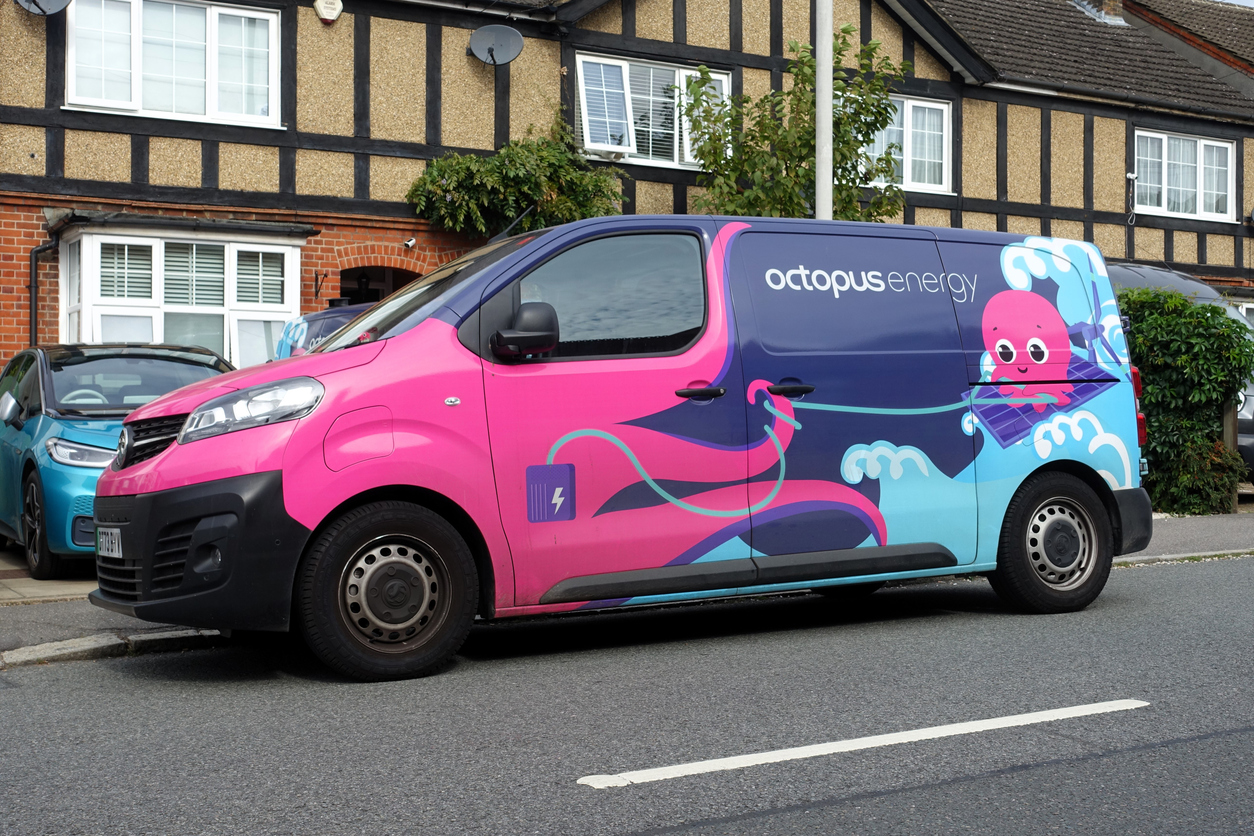
Octopus Energy is our best energy supplier overall for 2026, combining competitive tariffs, consistently strong customer ratings and the widest range of smart tariffs in the UK.
However, it will not be the right supplier for every household. 100Green currently leads the Citizens Advice customer service rankings, E.ON Next is a strong mainstream alternative and Good Energy stands out for its approach to renewable electricity.
The cheapest supplier will also depend on the tariff available in your area, how much energy you use and how you pay. This comparison therefore considers customer service, billing, tariff choice, smart technology and environmental credentials, rather than simply choosing whichever company happens to have the cheapest fixed tariff today.
Current market update: From 1 July to 30 September 2026, the average price-capped Direct Debit rates are 26.11p per kWh for electricity and 7.33p per kWh for gas. Average daily standing charges are 57.19p for electricity and 29.04p for gas. Rates vary by region, and the price cap limits rates rather than the total amount you can be charged.
Best UK energy suppliers comparison
| Category | Our pick | Why |
|---|---|---|
| Best energy supplier overall | Octopus Energy | Strong service, competitive everyday tariffs and the widest smart tariff range |
| Best for customer service | 100Green | First in the latest Citizens Advice customer service rankings |
| Best mainstream alternative | E.ON Next | Third for customer service and a broad choice of tariffs |
| Best smaller alternative | Outfox Energy | Second in the latest Citizens Advice rankings and competitive pricing |
| Best for smart tariffs | Octopus Energy | Specialist options for EVs, heat pumps, solar panels and batteries |
| Best for prepayment | E | A prepayment specialist and the highest-scoring supplier in the 2026 Which? assessment |
| Best for renewable electricity | Good Energy | Directly supports thousands of independent renewable generators |
| Best for green gas | 100Green | Supplies certified biomethane rather than relying solely on carbon offsets |
These are category recommendations rather than a definitive order based on price. The latest Which? assessment named E, Octopus Energy, 100Green and Sainsbury’s Energy as Recommended Providers. Citizens Advice currently ranks 100Green, Outfox Energy and E.ON Next as the top three suppliers for customer service, with Octopus fourth.
Who is the best energy supplier overall?
Our pick: Octopus Energy

Best for: Most households, particularly those with an electric vehicle, heat pump, solar panels, home battery or willingness to move their electricity use to cheaper periods.
Octopus Energy is our best overall energy supplier because it performs strongly across the areas that matter most without relying on a single selling point.
In the 2026 Which? assessment, Octopus finished second out of 17 suppliers with a total score of 74%. It received a customer score of 79% and was named a Which? Recommended Provider for the ninth consecutive year.
Octopus also placed fourth in the latest Citizens Advice customer service rankings, scoring 3.67 out of five. This put it behind 100Green, Outfox Energy and E.ON Next, but comfortably ahead of several other large suppliers.
The main advantage of Octopus is its tariff range. Alongside conventional fixed and variable tariffs, it offers:
- Agile Octopus, with electricity prices changing every half hour
- Octopus Tracker, with prices that change daily
- Intelligent Octopus Go and Octopus Go for EV charging
- Cosy Octopus for heat pumps
- Import and export tariffs for homes with solar panels and batteries
That gives customers more opportunities to choose a tariff around how their home actually uses energy. Agile, Tracker and the Intelligent tariffs require a working smart meter, while some specialist tariffs also require compatible technology.
Octopus will not always be the cheapest supplier for every postcode, and its more complex tariffs are not automatically better. Agile, for example, can become expensive during peak periods, while EV and battery tariffs only make sense when the household can take advantage of their cheaper windows.
For someone who wants a straightforward tariff, it is still important to compare Octopus against the best fixed and variable deals available elsewhere.
Our verdict: Octopus offers the strongest overall combination of service, tariff choice and smart-energy technology. It is particularly difficult to beat for households moving towards an EV, heat pump, solar panels or battery.
See our full guide to Octopus Energy tariffs to compare its everyday, smart and export options.
Best energy supplier for customer service
100Green
Best for: Households that place customer service and environmental credentials above finding the lowest possible price.
100Green is currently first in the Citizens Advice energy supplier customer service table, scoring 4.33 out of five for January to March 2026.
It performed well across complaints, contact waiting times, billing and metering, and commitments to customers. It also received the highest customer score in the 2026 Which? survey at 82% and was named a Which? Recommended Provider.
The supplier is also unusual because it offers certified green gas produced from biomethane. Most domestic gas tariffs still supply fossil gas, even where carbon emissions are offset or the tariff is marketed as green. Biomethane is produced from organic material and injected into the national gas grid.
The main drawback is price. Smaller green suppliers are not normally the first place to look for the cheapest fixed deal, and 100Green has a much narrower tariff range than Octopus or the major suppliers.
Our verdict: Choose 100Green when customer service and genuinely renewable gas matter more to you than having the cheapest tariff or widest product range.
Best mainstream alternative to Octopus
E.ON Next
Best for: Households that want a large, established supplier with competitive tariffs and improving customer service.
E.ON Next is the strongest mainstream alternative to Octopus in the latest Citizens Advice results. It finished third with a score of 3.71 out of five, slightly ahead of Octopus.
It performed particularly well for billing and metering and received the maximum score for its wider customer commitments. Citizens Advice describes E.ON Next, Octopus and OVO as the best-performing companies among the six largest suppliers.
Its Which? result was less impressive. E.ON Next received a total score of 66% and was not named a Recommended Provider. This difference is partly explained by the two organisations measuring different things. Citizens Advice uses operational data such as complaints, billing, smart-meter reliability and contact times, while Which? combines customer opinions with an assessment of supplier policies and practices.
E.ON Next offers standard tariffs alongside specialist options for electric vehicles and other flexible energy use. Its fixed deals can also be competitive, although prices, availability and exit fees change regularly.
Our verdict: E.ON Next is worth comparing with Octopus when you want a larger supplier, particularly if its current tariff works out cheaper for your home.
Best smaller alternative
Outfox Energy
Best for: Households prepared to choose a smaller supplier in exchange for competitive pricing and strong recent service results.
Outfox Energy finished second in the latest Citizens Advice customer service rankings with 4.25 out of five. It received strong scores for contact waiting time, billing and metering, and customer commitments.
It also finished joint fourth in the overall Which? table with a total score of 71%, although it was not named a Which? Recommended Provider.
Outfox has often competed aggressively on tariff price, making it worth including in a whole-market comparison. As with any smaller supplier, check its current tariff terms, payment method, exit fees and recent customer service performance before switching.
Our verdict: Outfox Energy is one of the strongest alternatives when its price is competitive and you are comfortable moving away from the largest household names.
Best energy supplier for prepayment
E
Best for: Pay-as-you-go customers who want a supplier focused on prepayment energy.
E, formally called E Gas and Electricity, was the highest-scoring company in the 2026 Which? assessment. It received a total score of 79%, including a customer score of 78%, and was named a Which? Recommended Provider.
The company specialises in prepayment energy. Customers with compatible smart meters can top up remotely, use emergency and friendly credit, and monitor their balance without relying entirely on a physical key or card.
Its Citizens Advice position was more mixed. E ranked ninth with a score of 3.22 out of five. It scored well for billing and metering and contact waiting times, but received a low complaints score.
That means we would not automatically describe E as the best supplier for every household, despite its Which? result. Its specialism makes it most relevant to people who actively want or need a prepayment account.
Our verdict: E is a strong option for prepayment customers, but compare its tariff and top-up arrangements with the prepayment services available from larger suppliers.
Best supplier for renewable electricity
Good Energy
Best for: Households that want their supplier to buy power directly from independent renewable generators.
Good Energy sources renewable electricity from more than 3,000 independent generators across Britain. These include solar, wind, hydro and biogeneration projects.
Which? gave Good Energy the highest score in its 2026 sustainability assessment, at 85%. It also received an 81% customer score, the second-highest in the survey, although its lower assessment of company policies brought its total score down to 69%.
Good Energy finished sixth in the latest Citizens Advice customer service rankings with 3.49 out of five. It scored particularly well for complaints and billing, although its contact waiting-time result was weaker.
Its tariffs may cost more than the cheapest deals from larger suppliers. The reason to choose it is not necessarily to secure the lowest unit rate, but to support a supplier that purchases power from independent renewable generators and takes a more direct approach to renewable electricity.
Our verdict: Good Energy is our preferred option for households that want to support independent renewable generation and are prepared to pay more when necessary.
How the main UK energy suppliers compare
The companies people recognise most readily are not always the highest-rated. Some smaller suppliers outperform the largest brands, while the big suppliers may offer broader tariff ranges, apps and specialist products.
| Supplier | Latest Citizens Advice position | Main strength | Our view |
|---|---|---|---|
| 100Green | 1st | Customer service and green gas | Best for service and renewable gas |
| Outfox Energy | 2nd | Service and competitive tariffs | Strong smaller alternative |
| E.ON Next | 3rd | Mainstream tariffs and billing | Best large alternative to Octopus |
| Octopus Energy | 4th | Smart tariffs and overall balance | Best overall |
| Co-op Energy | 5th | Service and Octopus-backed platform | Solid option, but compare it with Octopus directly |
| Good Energy | 6th | Renewable electricity | Best for supporting independent renewables |
| Ecotricity | 7th | Environmental investment | Ethical choice, but not usually price-led |
| OVO Energy | 8th | App and broad household support | Reasonable, but does not lead a category |
| E | 9th | Prepayment energy | Best suited to pay-as-you-go customers |
| ScottishPower | 10th | EV tariffs and renewable generation | Compare specialist tariffs carefully |
| EDF Energy | 11th | EV and heat-pump tariffs | Useful specialist options, weaker service score |
| British Gas | 13th | Familiar brand and engineer network | Service performance remains a concern |
The positions above come from the Citizens Advice results for January to March 2026. The assessment considers complaints, contact waiting times, billing and metering, and customer commitments. The next quarterly results are due in September 2026.
OVO Energy
OVO sits in the middle of the current Citizens Advice table. It offers a capable app, renewable electricity options and support for technologies such as EVs and heat pumps, but it does not currently lead on service, price or specialist tariffs.
It may still be suitable when one of its tariffs works particularly well for your household, but we would compare it with Octopus and E.ON Next before switching.
British Gas
British Gas may appeal to households that value a familiar brand, its engineer network or the ability to arrange energy and boiler cover through related services.
However, it finished thirteenth out of 16 suppliers in the latest Citizens Advice customer service table. It also received two stars in each customer-rated category reported by Which?, alongside EDF, OVO and ScottishPower.
EDF Energy
EDF has specialist tariffs aimed at households with electric vehicles and heat pumps. These may be worth considering when their off-peak periods suit your home.
Its wider customer service performance is less convincing. EDF placed eleventh in the latest Citizens Advice table, so we would only choose it where the tariff itself provides a clear advantage.
ScottishPower
ScottishPower has options for electric vehicles and customers interested in renewable electricity, but finished tenth in the latest Citizens Advice rankings.
As with EDF, the reason to choose it should usually be a specific tariff or feature rather than its overall customer service record.
How we chose the best energy suppliers
There is no single measurement that determines which energy supplier is best. A supplier can score well for customer satisfaction but less well when its policies are independently assessed. Another may offer good service but relatively expensive tariffs.
We considered the following factors.
Independent customer service results
The Citizens Advice Star Rating measures operational performance using complaints data, contact waiting times, billing and metering performance, and customer commitments.
This makes it useful for assessing how reliably a supplier handles everyday accounts and problems. It is not a direct measure of tariff price.
Customer opinions and supplier practices
Which? combines a customer survey with its own assessment of each supplier’s policies and behind-the-scenes practices.
Its customer score considers satisfaction and likelihood to recommend, while its wider assessment looks at areas including customer support, complaints, smart meters and help for people who need additional support.
Tariff range
We considered whether each supplier offers:
- Straightforward fixed and variable tariffs
- Smart time-of-use tariffs
- EV charging tariffs
- Heat-pump tariffs
- Solar export tariffs
- Options for home batteries
- Prepayment services
A wide tariff range is valuable, but only where the tariffs are suitable and understandable.
Pricing and contract terms
Tariff prices can change far more quickly than customer service rankings. A fixed tariff that looks competitive today may be withdrawn or replaced within days.
For that reason, this guide does not declare one supplier permanently cheapest. We look at whether the supplier is generally competitive, but you should still obtain a quote using your postcode and actual annual consumption.
Environmental approach
Many suppliers describe their electricity as renewable, but they do not all purchase or support renewable power in the same way.
We give additional credit to suppliers that buy electricity directly from renewable generators, invest in new generation or supply certified biomethane. We do not assume that every tariff marketed as green has the same environmental effect.
Suitability for different households
The best supplier for a standard gas-heated home may not be the best option for someone with an EV, heat pump, solar panels or prepayment meter.
Our category winners therefore reflect different household needs instead of forcing every supplier into a single ranking.
How to choose the right energy supplier
Compare the tariff, not just the company
Your supplier is responsible for billing, service and the range of products available, but the tariff determines what you actually pay.
Compare:
- Electricity and gas unit rates
- Daily standing charges
- Estimated annual cost using your consumption
- Tariff length
- Exit fees
- Whether prices are fixed or variable
Do not choose a tariff purely because its estimated annual figure looks lower. Check whether the quote uses accurate annual consumption rather than a generic household estimate.
Consider how much support you may need
Customer service matters more when something goes wrong.
A slightly cheaper tariff may not be worthwhile if the supplier performs poorly for billing, complaints or accessibility, particularly if you have previously experienced incorrect bills or smart-meter problems.
Check both Citizens Advice and Which? because they measure different aspects of supplier performance.
Look for tariffs that suit your home
A standard tariff may be sufficient when you use energy in a conventional way.
A specialist tariff may provide better value if you have:
- An electric vehicle that can charge overnight
- A heat pump that can run during cheaper periods
- A home battery that can charge and discharge strategically
- Solar panels exporting electricity
- Flexible appliances that can avoid expensive peak periods
See our comparisons of the best EV tariffs and best heat-pump tariffs before choosing a supplier solely because it offers one specialist product.
Check whether you need a smart meter
You do not normally need a smart meter to change supplier or join a conventional fixed or variable tariff.
You will usually need a working smart meter capable of sending half-hourly readings to access time-of-use tariffs such as Agile Octopus, Intelligent Octopus Go and other smart charging products.
Before switching for a specialist tariff, check that your meter, EV, charger, heat pump or battery is compatible.
Decide how important green energy is to you
A tariff labelled 100% renewable does not necessarily mean the supplier buys power directly from renewable generators at the same time its customers use it.
Look beyond the headline and consider:
- How the renewable electricity is purchased
- Whether the supplier has direct agreements with generators
- Whether it invests in new renewable generation
- How closely renewable purchases match customer demand
- Whether a green-gas claim uses biomethane or offsets
Good Energy and 100Green are strong options when environmental sourcing is one of your main priorities.
How switching energy supplier works
Once you choose a tariff, the new supplier normally handles the switch. Your gas and electricity continue without interruption and no one needs to replace the physical supply cables or pipes.
Domestic switches should be completed within five working days. You also have a 14-day cooling-off period for a new domestic energy contract.
You may be asked to provide meter readings around the switch date. These help your old supplier prepare its final bill and your new supplier open the account using the same readings.
Any remaining credit should be returned after the final account has been calculated. Read our full guide to switching energy supplier for the complete process.
Best energy supplier UK FAQ
Who is the best energy supplier in the UK?
Octopus Energy is our best overall energy supplier for 2026 because it combines strong independent customer ratings with competitive conventional tariffs and the broadest smart-tariff range.
It will not be best in every category. 100Green currently ranks first for customer service, Good Energy is our preferred option for directly supporting independent renewable generation, and E specialises in prepayment energy.
Who is the cheapest energy supplier right now?
There is no single cheapest supplier for every household.
The cheapest option depends on your postcode, annual energy use, payment method and the tariffs currently available. Two households can receive different estimated annual costs from the same supplier because regional standing charges and unit rates vary.
Use your actual annual electricity and gas consumption when comparing tariffs. You can find this on a recent bill or annual statement.
Is Octopus Energy really the best?
Octopus is the strongest all-round choice for many households, but it is not automatically the cheapest or highest-rated supplier in every assessment.
It finished second in the 2026 Which? table and fourth in the latest Citizens Advice customer service rankings. Its main advantage is the combination of competitive everyday tariffs, strong service and specialist tariffs for EVs, heat pumps, solar panels and batteries.
Which energy supplier has the best customer service?
100Green is first in the latest Citizens Advice rankings with a score of 4.33 out of five. Outfox Energy is second, followed by E.ON Next and Octopus Energy.
Which? uses a different methodology. Its 2026 Recommended Providers are E, Octopus Energy, 100Green and Sainsbury’s Energy.
Which is the best green energy supplier?
Good Energy is our preferred supplier for renewable electricity because it buys power from thousands of independent British renewable generators and received the highest score in the 2026 Which? sustainability assessment.
100Green is the stronger option if you also want certified green gas produced from biomethane.
Should I choose a small energy supplier?
A smaller supplier can provide excellent service and may offer competitive prices. 100Green and Outfox Energy currently occupy the top two places in the Citizens Advice customer service table.
However, check its current tariffs, payment methods, smart-meter support and recent performance before switching. Being smaller does not automatically make a supplier better or less secure.
What happens if my energy supplier goes bust?
Your energy supply will continue.
Ofgem normally appoints another company through its Supplier of Last Resort process. Domestic credit balances are protected, and you should wait for the newly appointed supplier to contact you before attempting to switch elsewhere.
Can I switch energy supplier if I am in debt?
Your supplier may object to a switch when you owe money on a credit account, depending on how old the debt is and the circumstances.
Different rules apply to prepayment customers. You can normally switch through the Debt Assignment Protocol when you owe no more than £500 for gas and £500 for electricity, provided the new supplier agrees to take on the debt.
Contact your supplier and agree an affordable repayment arrangement if debt is preventing you from switching.
Do I need a smart meter to change energy supplier?
No. You can switch supplier and join most standard fixed or variable tariffs without a smart meter.
A working smart meter is normally required for tariffs that use half-hourly readings, automated EV charging or prices that change at different times of day.
Will my energy supply be interrupted when I switch?
No. Your home remains connected to the same electricity and gas networks throughout the switch.
Only the company responsible for billing you and purchasing your energy changes. The new supplier manages the transfer with your existing supplier.