
If you’ve spent ten minutes reading about heat pumps online, you’ve probably come away more confused than when you started. One article calls them the future of home heating. The next one tells you about someone’s mate who had one fitted and now shivers through February in three jumpers. Somewhere in the middle, there’s an answer that actually applies to your house, and that’s what this guide is about.
So, are heat pumps worth it in the UK in 2026? The short, honest answer: for some homes, absolutely. For others, not yet, and not without doing some other work first. This guide walks through the costs, the grants, the running costs, and the specific situations where a heat pump is a genuinely smart move versus where it really isn’t. No cheerleading. No doom. Just the numbers and the caveats.
Who this guide is for
You’re a UK homeowner. You’ve got a gas or oil boiler that’s either on its last legs or at the age where you’re starting to worry about it. You’ve heard about the £7,500 government grant, you’re curious, but you’re also not keen to spend £10,000-plus on something you don’t fully understand. You want a straight answer about whether a heat pump makes sense for your house, not in the abstract.
By the end of this, you’ll have one.
What a heat pump actually is (without the thermodynamics lecture)
A heat pump is basically a fridge running backwards. A fridge moves heat from inside the fridge out into your kitchen. A heat pump does the opposite. It moves heat from outside your house (from the air, or the ground) into your home, and uses that heat to warm your radiators and hot water.
The clever bit is that because it’s moving heat rather than generating it, it produces more heat energy than the electricity it consumes. A decent heat pump will turn 1 unit of electricity into roughly 3 to 4 units of heat. A gas boiler, by contrast, produces slightly less than 1 unit of heat per unit of gas burned. That efficiency gap is the whole argument for heat pumps, and it’s why running costs can work out lower even though electricity is more expensive per unit than gas.
There are three main types you’ll come across:
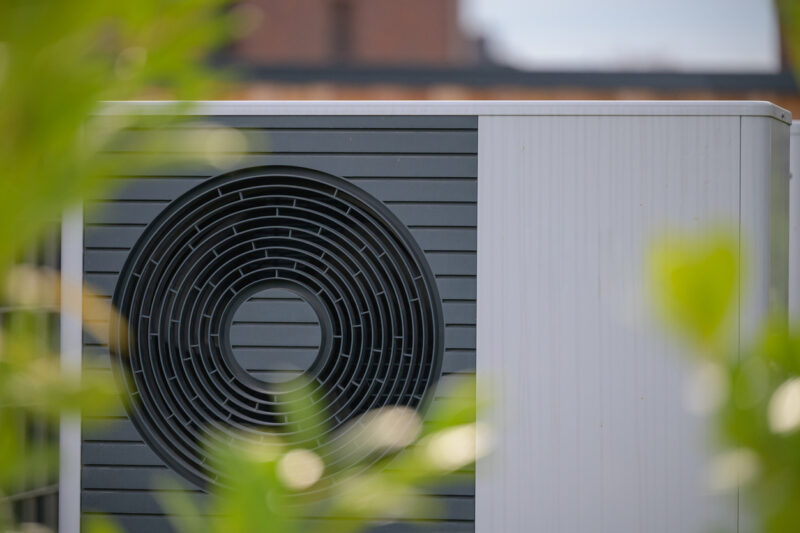
- Air source heat pump (ASHP). An outdoor unit about the size of a large washing machine, usually bolted to an outside wall. By far the most common. This is what most of the grant money and most of this guide is aimed at.
- Ground source heat pump (GSHP). Extracts heat from underground via pipes buried in your garden. More efficient than air source, but the groundworks are expensive and you need space.
- Air-to-air heat pump. Pulls heat from outside and blows warm air into rooms via indoor units, like a reverse air con. Doesn’t produce hot water. Common in flats and small properties. Historically excluded from the main UK grant but that’s changing, see below.
If any of this talk about “unit rates” and “kWh” is already making your eyes glaze over, it’s worth a quick detour through Understanding Your Energy Bills – A Complete Guide first. The rest of this article will make more sense once you’ve got the basics of how you’re billed for energy.
How much does a heat pump cost in 2026?
Here’s where you get conflicting answers depending on who you ask. Installers have an incentive to quote high. Government press releases have an incentive to quote low. The truth is in between, and it varies wildly by property.
These are typical installed cost ranges in 2026, before any grant is applied:
| System type | Typical installed cost (before grant) | What drives the variation |
|---|---|---|
| Air source heat pump (ASHP) | £8,000 – £15,000 | Property size, radiator upgrades, hot water cylinder, pipework |
| Ground source heat pump (GSHP) | £18,000 – £35,000 | Groundworks, drilling or trenching, garden access |
| Air-to-air heat pump | £3,000 – £7,000 | Number of indoor units, ducting |
A quick note on what’s actually in that ASHP figure. It’s not just the unit itself. A proper install usually includes a new hot water cylinder (because heat pumps work at lower flow temperatures than boilers and need more hot water storage), upgrades to some or all of your radiators (because lower flow temperatures need bigger radiators to kick out the same amount of heat), and sometimes rewiring or pipework. This is where the quote can balloon. A straightforward install in a well-insulated modern semi might come in at the bottom of that range. A 1930s solid-wall property with tiny microbore pipework and single-panel radiators can end up at the top.
The golden rule: get three quotes. Not two, not one from the first bloke who knocked on your door after you filled in an online form. Three. The variation between installers for the same house can be thousands of pounds, and the cheapest isn’t always the best. Quality of the heat loss survey matters more than brand of heat pump.
Grants and funding in 2026
This is where it gets genuinely interesting, because the current grant regime is the most generous it has ever been.
The Boiler Upgrade Scheme (BUS)
If you live in England or Wales, the Boiler Upgrade Scheme gives you:
- £7,500 towards an air source heat pump
- £7,500 towards a ground source or water source heat pump
- £2,500 towards an air-to-air heat pump (expected to become available during 2026, once MCS standards are finalised)
- £2,500 towards a heat battery (also expected during 2026)
- £5,000 towards a biomass boiler (rural off-grid only)
The grant is deducted from your invoice by an MCS-certified installer before you pay. You don’t claim it back yourself, you don’t wait for a cheque, it just comes off the top of the bill.
A few things worth knowing about the scheme in 2026:
- It has been extended to 2030, so the pressure to install immediately has eased. That said, budgets are finite and demand is growing, so “we’ve got years” isn’t quite the same as “we’ve got forever”.
- From 2026/27, the requirement for a valid EPC with no outstanding insulation recommendations is being relaxed. You’ll be able to provide alternative evidence if no EPC exists. This removes one of the more annoying barriers.
- There’s 0% VAT on energy-saving materials including heat pumps, running to 31 March 2027. That saving is already baked into installer quotes.
- One grant per property. You can’t double up.
- New-builds don’t qualify (except self-builds).
Scotland and Wales (and Northern Ireland)
BUS is England and Wales only. If you’re elsewhere:
- Scotland. Home Energy Scotland offers a grant of up to £7,500 for an air source heat pump (£9,000 with the rural uplift), plus an interest-free loan of up to £7,500 on top. Total support can reach £15,000.
- Wales. Welsh homeowners access BUS. Households on means-tested benefits may also qualify for the Nest scheme, which can cover heating improvements in full.
- Northern Ireland. There’s no direct equivalent to BUS, but the Northern Ireland Sustainable Energy Programme and Housing Executive schemes may offer support for eligible households.
And for anyone on qualifying benefits anywhere in the UK, the ECO4 scheme can sometimes fund a heat pump install in full through your energy supplier, though the criteria are tight and the waiting list isn’t short.
Running costs vs a gas boiler
This is the bit most people actually want to know. Will it save me money every month, or is the grant the only real saving?
The honest answer: it depends on your house, your tariff, and the efficiency of the install. But let’s do the maths with realistic 2026 numbers.
First, a quick definition. SCOP stands for Seasonal Coefficient of Performance. It’s the average efficiency of a heat pump across a full year, including the cold months. A SCOP of 3.5 means the heat pump produces 3.5 units of heat for every 1 unit of electricity it uses. A well-installed air source heat pump in a reasonably insulated home should hit a SCOP of 3.0 to 4.0. A poorly installed one in a draughty house might only hit 2.5, and that’s where the horror stories come from.
Now the numbers. Using the Ofgem price cap rates for April to June 2026 (roughly 24.7p per kWh for electricity and 5.7p per kWh for gas), here’s a comparison for a typical 3-bed semi with an annual heat demand of around 12,000 kWh:
| Heating system | Efficiency | Electricity used | Gas used | Estimated annual fuel cost |
|---|---|---|---|---|
| Old non-condensing gas boiler | ~75% | – | 16,000 kWh | £912 |
| Modern condensing gas boiler | ~90% | – | 13,333 kWh | £760 |
| Heat pump (SCOP 3.0) | 300% | 4,000 kWh | – | £988 |
| Heat pump (SCOP 4.0) | 400% | 3,000 kWh | – | £741 |
Figures rounded. Based on April 2026 Ofgem price cap unit rates, excluding standing charges, which apply regardless of heating system. Assumes a heat demand of 12,000 kWh per year.
Look at that table carefully, because there are a couple of uncomfortable truths in it. At a SCOP of 3.0, a heat pump actually costs slightly more to run than a modern condensing gas boiler at current price cap rates. It’s only when SCOP climbs to 3.5 or 4.0 that the running costs start to look clearly better than gas.
This is the bit the heat pump crowd on social media sometimes skip over. The ratio between electricity and gas unit prices in the UK is, by European standards, terrible for heat pumps. Our electricity is unusually expensive relative to our gas. This is a known problem that the government has said it wants to fix through “rebalancing”, but it hasn’t happened yet.
That said, there are two huge caveats that make heat pumps much more attractive than the table suggests:
- Tariffs matter enormously. Specialist heat pump tariffs (like Octopus Cosy, or Economy 7 variants) offer cheaper electricity for several hours a day, when the heat pump can do most of its work. On these tariffs, running costs can drop significantly, often to below gas boiler levels even at modest SCOP. It’s worth reading Energy Tariffs Explained before you decide if a heat pump is uneconomic, because the wrong tariff can make a good install look bad.
- If you’re on oil or LPG, the maths flips completely. Heating oil runs at roughly 7-9p per kWh equivalent, and LPG is worse. Against those, a heat pump at SCOP 3.0 is significantly cheaper to run, typically saving £500 to £1,000+ a year.
If your bills are already sky-high for reasons that aren’t really about the heating system itself (poor insulation, old windows, general leakiness), swapping the boiler for a heat pump won’t fix that. Why Are My Energy Bills So High? is worth a read if that sounds like you. Fix the fabric first, then think about heat pumps.
When a heat pump is genuinely worth it
Skip the marketing. Here’s the honest list of situations where a heat pump is a very good idea in 2026:
- You’re currently heating with oil or LPG. The running cost savings are the biggest here, and the payback period is the shortest. If this is you, stop reading and get quotes.
- Your home is reasonably well insulated. Loft insulation done, cavity walls filled, double glazing. Doesn’t need to be a Passivhaus. Just not leaky.
- Your radiators are already decent-sized, or you’re willing to upgrade a few of them. Double-panel radiators of reasonable size will generally work at heat pump flow temperatures. Tiny microbore-fed single panels will not.
- You’ve got space for an outdoor unit. A yard, a bit of wall, a garden. Not a second-floor flat with no external wall.
- You’re planning to stay in the property for 8+ years. The payback maths only really works if you benefit from the running cost savings yourself.
- You’re comfortable running heating differently. Heat pumps like to run low and slow, not blast-on-blast-off. If you currently whack the boiler on for an hour morning and evening, you’ll need to adjust.
- Your existing boiler is old and due replacement anyway. The comparison isn’t “free boiler vs £10k heat pump”. It’s “£3k new boiler vs £10k heat pump minus £7.5k grant”. Suddenly the maths is a lot friendlier.
A quick suitability checklist
Tick these off honestly:
- My loft has insulation and my cavity walls are filled (or it’s solid-wall and I’m prepared to insulate)
- I have space outside for a unit roughly 1m x 1m x 0.4m, not directly against a bedroom window
- My existing radiators are reasonable size (not tiny single panels throughout)
- I plan to still be living here in 8+ years
- I’m okay with the heating running more of the time at lower temperatures rather than blasting on and off
- My current boiler is either due replacement or I’m prepared to replace it early
Five or six ticks? Probably worth getting quotes. Two or three? Read on.
When a heat pump probably isn’t worth it (yet)
Equally important, and more honest than most articles will be:
- Solid-wall Victorian terrace with no intention to insulate. The heat loss is enormous. A heat pump will either be undersized and leave you cold, or correctly sized and run up large electricity bills. Fix the fabric first.
- Flats with no outdoor space and no permission for an external unit. Air-to-air might be an option (with the new £2,500 grant when it lands), but not air-to-water.
- You’re planning to move in the next 3-4 years. The running cost savings take years to accumulate. A heat pump doesn’t always add to resale value pound-for-pound, especially if the buyer doesn’t care.
- You heat in short intense bursts and refuse to change that. Heat pumps can do it, badly. You’ll hate the experience.
- Your quote has ballooned past £15k because the installer wants to replace every radiator and rebuild your hot water system. Either the quote is wrong or your house genuinely isn’t ready. In both cases, pause.
- You’re on gas, insulation is poor, and you can’t or won’t improve it. Be realistic. The numbers don’t work.
None of this is permanent. A house that’s wrong for a heat pump in 2026 might be right in 2029 after some insulation work and as heat pump costs keep falling. This is a “not yet” list, not a “never” list.
“But will it actually keep my house warm?”
Yes. This is the question people ask most and it’s the one that tabloids have done the most to muddy.
Modern heat pumps work perfectly well in UK winters. They work in Norway. They work in Finland. They work at minus 15. They will work in Birmingham in January. The idea that they “can’t cope with the cold” is a hangover from early systems and botched installs.
The catch, and it’s worth being clear about this, is that heat pumps are designed to run low and slow. The flow temperature going into your radiators is lower than a gas boiler (typically 35-50°C instead of 60-70°C), which means radiators feel warm rather than hot. The heat pump runs for longer periods, often most of the day in winter, maintaining a steady indoor temperature rather than swinging it up and down.
This is a behavioural adjustment. If you’re someone who likes the boiler off during the day and then roaring for an hour when you get home, a heat pump will feel odd at first. If you live in the house most of the day and prefer a steady ambient temperature, you’ll probably prefer it to a boiler.
The single biggest factor in whether a heat pump “keeps you warm” is not the brand of heat pump. It’s the quality of the installer’s heat loss survey and system design. A good installer will get this right. A bad one will size it wrong, set the flow temperature wrong, and leave you cold. This is why the three quotes rule matters so much.
Payback period: the honest maths
Let’s do some realistic scenarios. These assume the £7,500 BUS grant is applied, a typical installed cost around £11,000, and April 2026 price cap rates.
| Scenario | Net install cost (after grant) | Annual running cost saving | Payback period |
|---|---|---|---|
| Oil boiler → heat pump (well-insulated) | £3,500 | £500–£900 | 4–7 years |
| Gas boiler → heat pump (well-insulated, good tariff) | £3,500 | £100–£300 | 12–35 years |
| Gas boiler → heat pump (poorly insulated) | £3,500+ | Often near zero or negative | Rarely pays back |
Illustrative only. Actual results depend on heat loss, tariff choice, SCOP achieved, and installer quality.
Now, an honest observation. The payback for gas-to-heat-pump is not the main reason to do it in 2026. If you’re being strict about money only, a well-maintained modern condensing gas boiler at SCOP-equivalent 90% will often be cheaper to run than a heat pump on a standard tariff. The reasons to switch are a combination of: your boiler dying anyway, wanting lower carbon emissions, wanting to get ahead of future gas price rises, and capturing the grant while it’s generous.
If you’re currently on oil, the picture is completely different and a heat pump is close to a no-brainer financially.
Choosing an installer
Three things matter, in this order:
- MCS certification. Non-negotiable. You cannot access the Boiler Upgrade Scheme grant without an MCS-certified installer. They’re also the ones who will do a proper heat loss calculation, which is the single most important bit of the whole process. Find them via the MCS directory.
- Quality of survey. A good installer will spend an hour or two in your house, measuring rooms, checking radiators, checking insulation, and producing a room-by-room heat loss calculation. A bad one will quote off a postcode and a bedroom count. If someone offers you a firm price without a proper survey, bin the quote.
- Quote detail. You want to see: model of heat pump, SCOP figure, which radiators are being upgraded, hot water cylinder size, pipework changes, total price, grant deduction, net price. Vague quotes hide nasty surprises.
Larger suppliers like Octopus Energy Services offer fixed-price heat pump installs as one route and can sometimes be competitive, especially for straightforward properties. They’re worth including in your three quotes alongside independent MCS installers. But don’t limit yourself to one big name. Smaller independent installers with strong local reviews are often excellent, and some are better designers than the big volume outfits.
Red flags to walk away from:
- Pressure to sign that day
- Unwillingness to provide a written heat loss calculation
- Quote based purely on “house size” with no room-by-room survey
- Reluctance to show you previous installs or references
- A heat pump that looks wildly over-sized or under-sized compared to the two other quotes you’ve got
Trade-offs and what this guide doesn’t cover
This guide focuses on the mainstream case: a homeowner in a standard UK property considering replacing a gas or oil boiler with an air source heat pump (or occasionally a ground source). Things I haven’t gone into:
- District heat networks. If you’re on one, you’re not choosing anyway.
- Hybrid systems (heat pump plus gas boiler). Still not eligible for BUS, though policy conversations are ongoing. They can make sense in specific cases but complicate the picture.
- High-temperature heat pumps for listed buildings or homes where radiator upgrades aren’t possible. These exist but are less efficient and need specialist installers.
- Commercial installs and anything beyond a domestic home.
- DIY setups. Don’t.
If any of those apply to you, find a specialist rather than taking general advice.
Frequently asked questions
Will a heat pump work in an old house? Often yes, but it depends on how leaky the house is and whether the radiators can be upgraded. A 1930s semi with cavity walls and loft insulation is usually fine. A 1890s solid-wall terrace with single glazing is a much harder case until the fabric is improved.
Do I need to replace all my radiators? Usually some, rarely all. A proper heat loss survey will tell you which rooms need bigger radiators. Often it’s two or three in the coldest rooms, not the whole house.
How noisy are heat pumps? Much quieter than people think. Modern units run at roughly 40-50 decibels at a metre away, quieter than a dishwasher. Siting matters. Not directly outside a bedroom window, not enclosed in a sound-trapping alcove.
Can I get a heat pump in a flat? Air-to-water is usually tricky because you need outdoor space and a hot water cylinder. Air-to-air is often more realistic, and from 2026 the £2,500 BUS grant should apply. Check with your freeholder and any leasehold restrictions before you get too excited.
Is the Boiler Upgrade Scheme still running in 2026? Yes, and it has been extended to 2030. The grant levels remain £7,500 for air source and ground source, with the £2,500 air-to-air grant expected to go live during 2026 once MCS standards are finalised.
Do I need a new hot water cylinder? Usually, yes. Heat pumps generally need a larger hot water cylinder than a combi boiler has (if any). This is factored into quotes, but it does mean finding the space for one.
Can I keep my gas boiler as a backup? Not under the BUS rules. The grant requires the fossil fuel system to be removed or permanently decommissioned. Keeping both isn’t compatible with the grant.
So, are heat pumps worth it?
Quick summary by situation:
- Oil or LPG household. Almost certainly yes. Get three quotes this month.
- Well-insulated gas household, staying put 8+ years, boiler due replacement. Yes, with the caveat that you should budget for a heat pump friendly tariff and be realistic that running cost savings vs a new gas boiler are modest at current electricity prices.
- Poorly insulated gas household. Fix the insulation first. Come back to the heat pump question in two years.
- Flat dweller with no outdoor space. Probably not, at least until the air-to-air grant goes live and you’ve checked your lease.
- Moving within 3 years. No. Let the next owner decide.
Heat pumps in 2026 are a very good option for the right house and a bad one for the wrong house. The technology works. The grants are generous. The running costs are defensible on the right tariff. But they’re not magic, and anyone telling you otherwise is either selling you one or has never looked at the numbers.
If you’ve read this far and think your house is a candidate, the next step is three quotes from MCS-certified installers, with proper heat loss surveys, and a careful read of your options on heat pump friendly tariffs. If you want a broader look at cutting your energy costs across the board, How to Actually Slash Your Energy Bills is a good next stop.
Good luck. It’s a big decision, and it’s worth getting it right.