
Switching to Octopus Energy is straightforward. You can get a quote online, choose your tariff and complete the switch without needing to contact your current supplier.
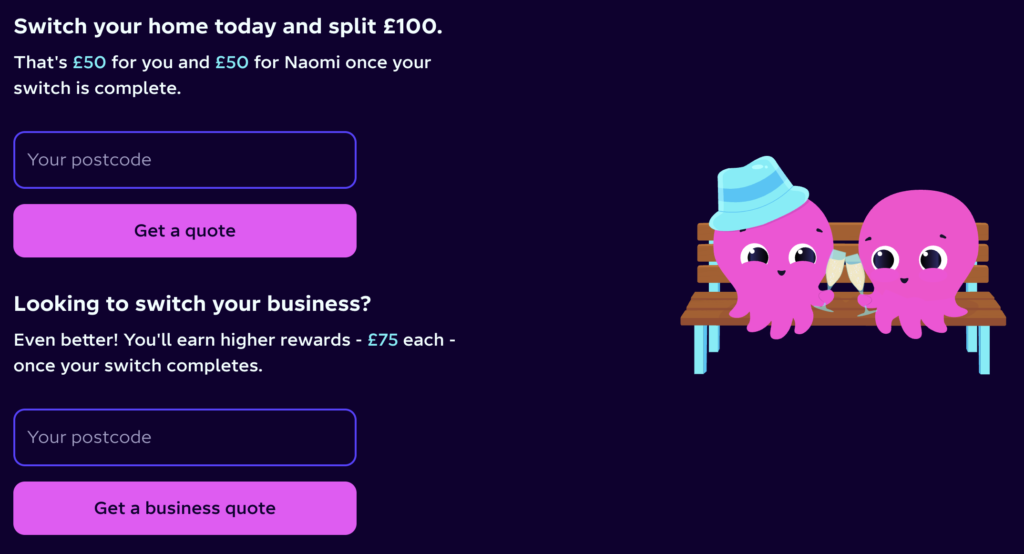
If you are a new Octopus Energy customer, you can also receive £50 account credit when you switch through an Octopus Energy referral link.
This guide takes you through how to switch to Octopus Energy step by step, what you need before you start and what happens after your supply moves over.
Before you switch to Octopus Energy
It is worth checking a few things before starting your switch.
- Check whether your current tariff has exit fees. Standard variable tariffs normally do not have exit fees, while some fixed tariffs do. If you are near the end of a fixed deal, check whether you can leave without paying a fee.
- Check your account balance. If you have an outstanding debt with your existing supplier, this can sometimes affect whether your switch can go ahead.
- Keep your current Direct Debit active. Your old supplier may still need to collect or refund money when it produces your final bill.
- Check whether you are on the Priority Services Register. If you use the Priority Services Register with your existing supplier, you will need to register with Octopus after switching.
You do not need to contact your current supplier before starting the switch. Octopus handles that part for you.
How to switch to Octopus Energy
You can complete most of the switching process online. Here is what happens from getting your quote through to becoming an Octopus customer.
Step 1. Click on our Octopus referral link
If you are a new customer, start your switch through an Octopus Energy referral link to qualify for the £50 account credit.
There is no referral code to type in manually. Starting your quote through the referral link connects the offer to your new account.
Step 2. Get a quote
Enter your postcode and estimated energy use to see the tariffs available for your home.
Having a recent energy bill can make it easier to provide an accurate estimate, but you do not need to know your exact annual usage before starting.
Octopus will show the available tariffs alongside an estimated monthly payment.
Do not focus only on the monthly Direct Debit amount. Check the unit rates, standing charges, tariff length and any exit fees before deciding which tariff to choose.
Step 3. Complete your sign-up
Once you have chosen a tariff, enter your personal, supply and payment details.
You will usually need information such as:
- your name and contact details
- your home address
- details of your current energy supply
- your bank account number and sort code if paying by Direct Debit
Once the application is complete, Octopus starts the switch for you.
Step 4. Your energy supply moves to Octopus
Your gas and electricity will continue working normally while the switch takes place.
There is no physical change to the electricity wires or gas pipes supplying your home. The main change is which company manages your account and bills you for the energy you use.
Your supply will usually move to Octopus within a few working days.
You do not normally need to contact your old supplier. Octopus will notify them that your supply is moving.
Around the transfer date, you may be asked to provide an opening meter reading. This helps your old supplier produce an accurate final bill and gives Octopus the correct starting point for your new account.
If your smart meter is communicating properly, readings may be collected automatically.
Step 5. Receive your £50 credit
If you joined using an eligible referral link, your £50 Octopus Energy credit will be added to your account after the switch has completed and the requirements of the referral offer have been met.
It normally appears automatically, so you should not need to claim the credit separately.
You can read our full Octopus Energy referral guide if you want to understand how the offer works before starting your switch.
What happens after you switch to Octopus Energy?
Once your supply has moved across, there are still a few things to expect.
Your old supplier sends a final bill
Your previous supplier will calculate your final energy use up to the date your supply moved to Octopus.
If your account is in credit, any remaining balance should be refunded. If you still owe money, your old supplier will ask you to pay the outstanding amount.
This is one reason to leave your previous Direct Debit in place until the final account has been settled.
Your Octopus account becomes your main energy account
You can manage your account online or through the Octopus Energy app.
This is where you can view bills, submit meter readings, check your balance, manage payments and view your energy use.
You can move to another Octopus tariff
The tariff you choose when joining does not necessarily have to be the tariff you stay on.
Some households initially join on a standard Octopus tariff before moving onto one of its smart tariffs.
If the tariff you want requires half-hourly meter data, Octopus may first need to confirm that your smart meter is communicating properly.
Once everything is ready, you may be able to move to a tariff better suited to your EV, heat pump, solar panels, battery or energy-use pattern.
Which Octopus Energy tariff should you switch to?
There is no single Octopus tariff that is best for every home.
If you simply want a conventional energy tariff without needing to change when you use electricity, Flexible Octopus or one of Octopus Energy’s fixed tariffs may be more suitable.
Octopus also offers smart tariffs designed around particular types of households and energy use.
For example:
- Octopus Tracker uses energy prices that change each day.
- Agile Octopus has electricity prices that change every half hour.
- Octopus Go offers cheaper overnight electricity aimed at EV charging.
- Intelligent Octopus Go combines cheaper overnight electricity with automated smart charging for compatible EVs and chargers.
- Cosy Octopus is designed around homes using heat pumps.
- Octopus Flux and other export tariffs are aimed at households with solar panels and batteries.
You can explore all Octopus Energy tariffs before deciding which option suits your home.
Energy prices and tariff terms can change, so always check the latest rates and conditions before switching.
Switching to Octopus with an EV, heat pump or solar panels
One of the main reasons people consider Octopus is its range of tariffs for homes using low-carbon technology.
You do not necessarily need to choose one of these tariffs during the initial switch.
EV drivers
Octopus offers several EV tariffs, including Octopus Go and Intelligent Octopus Go.
These offer cheaper electricity at certain times to help reduce the cost of charging an electric car at home.
Some smart EV tariffs require a compatible car or charger and a working smart meter.
Heat pump households
Cosy Octopus is designed for homes using heat pumps and provides several cheaper electricity periods throughout the day.
This can make it possible to shift more heating and hot-water demand into lower-cost periods.
Solar and battery owners
Octopus also offers several export tariffs for households sending electricity back to the grid.
Options include Outgoing Octopus and tariffs designed around solar panels and home batteries.
If you already generate or store electricity, it is worth comparing your import and export tariffs together rather than choosing each one in isolation.
Is Octopus Energy worth switching to?
Octopus can be a good option if you want access to a wide range of tariffs, particularly if you have an EV, heat pump, solar panels or home battery.
Its standard tariffs are also available for households that do not want to use smart time-of-use pricing.
However, switching supplier does not automatically mean your energy bills will fall.
The amount you pay still depends heavily on your tariff rates and how much gas and electricity your household uses. Another supplier may sometimes offer a cheaper deal, particularly if you are comparing fixed tariffs.
That is why it is worth comparing the actual unit rates, standing charges and tariff terms before switching rather than choosing a supplier based on the estimated monthly Direct Debit alone.
If you have decided Octopus is right for you, the switching process itself is relatively simple and Octopus handles most of the move from your previous supplier.
Other benefits of being an Octopus Energy customer
Tariffs are only one part of the Octopus offering.
Depending on your meter and eligibility, Octopus customers may also be able to access:
- Octoplus, Octopus Energy’s rewards programme
- Saving Sessions, where eligible customers can be rewarded for reducing electricity use at certain times
- Free Electricity sessions, where eligible customers can benefit from periods of free electricity
- the Octopus Home Mini, which provides much more detailed information about electricity use through the Octopus app
These should not be the main reason for choosing an energy supplier, but they can be useful extras once you are an Octopus customer.
Switch to Octopus Energy FAQ
How long does it take to switch to Octopus Energy?
Most switches complete within a few working days.
The exact timing can vary depending on your circumstances and whether Octopus needs any additional information about your supply.
Will my gas or electricity be interrupted when I switch?
No.
Your home continues using the same electricity wires, gas pipes and meters. Switching supplier changes who manages and bills your energy account, not the physical supply to your home.
Do I need to contact my old energy supplier?
Normally, no.
Octopus handles the switch and your previous supplier will be notified automatically. Your old supplier will then produce a final bill for the energy used up to the transfer date.
Do I need a smart meter to switch to Octopus Energy?
No.
You can switch to Octopus without a smart meter.
However, some Octopus smart tariffs require a working smart meter capable of sending the meter data needed to calculate your bill.
Can I switch to Octopus with a prepayment meter?
Yes. Octopus supports customers using prepayment meters.
The exact switching process can depend on the type of prepayment meter you have.
What happens if I owe my current energy supplier money?
An outstanding balance does not always prevent you from changing supplier, although older energy debt can sometimes result in your existing supplier objecting to the switch.
If you are unsure, check your account with your current supplier before starting the move.
Is there a cooling-off period when switching to Octopus?
Yes. Energy switches normally include a 14-day cooling-off period after signing up.
If you change your mind during this period, contact Octopus as soon as possible.
Does Octopus Energy charge exit fees?
It depends on the tariff.
Some Octopus tariffs have no exit fees, while other fixed or specialist tariffs may charge one.
Because tariff terms can change, check the conditions shown with your quote before signing up.
When will I receive the £50 Octopus Energy credit?
If you are eligible for the referral offer and started your switch through a referral link, the £50 credit is added to your Octopus account after the switch and qualifying payment requirements have been completed.
It can take a little time to appear after your supply moves across.
Is Octopus Energy always the cheapest supplier?
No.
Energy prices change and the cheapest supplier or tariff will depend on your home, usage and the deals available at the time.
Octopus’s main advantage is the combination of standard tariffs and more specialised options for households that can benefit from smart pricing.
Ready to switch to Octopus Energy?
If you have compared the available tariffs and decided Octopus is right for your home, you can start your switch online.
New customers who switch through our referral link can receive £50 Octopus Energy account credit once the qualifying conditions have been met.
Switch to Octopus Energy and get £50 credit
We may receive a referral payment if you sign up through links on this site, at no extra cost to you. Energy prices and tariff terms can change, so always check the latest rates before switching.