
Intelligent Octopus Flux is a smart import and export tariff for homes with solar panels and a compatible battery. This guide covers the latest Intelligent Octopus Flux tariff rates, how the automated battery control works, who can join and whether the tariff could suit your home.
What are the Intelligent Octopus Flux tariff rates?
Intelligent Octopus Flux tariff rates vary by region. Select your area below to see the current import rates, export rates and electricity standing charge available where you live.
What is Intelligent Octopus Flux?
Intelligent Octopus Flux is a smart import and export tariff from Octopus Energy for homes with solar panels and a compatible home battery. It is often shortened to IOF or Intelligent Flux.
The tariff is designed to help solar and battery households make better use of stored electricity without manually setting charge and discharge schedules. Octopus connects to your compatible battery and automatically manages when it charges, holds energy or exports electricity back to the grid.
A key feature of Intelligent Octopus Flux is that import and export rates are the same price within each pricing period. This means the amount you pay to import electricity and the amount you are paid to export electricity are the same during that same time window.
Like standard Octopus Flux, it has a higher-value peak period from 4pm to 7pm. The difference is that Intelligent Octopus Flux can automatically prepare your battery for that period, then use or export stored electricity when it is most valuable.
Note: Intelligent Octopus Flux is not available to every solar and battery household. You need to be an Octopus electricity customer, have eligible solar and export setup, and use a battery system that Octopus can connect to and control.
How does Intelligent Octopus Flux work?
Intelligent Octopus Flux combines time-of-use import and export rates with automatic battery control.
Instead of you manually deciding when your battery should charge, hold energy or export, Octopus manages the battery for you. The aim is to use cheaper and greener electricity when it is available, then use or export stored electricity when it is more valuable.
Matched import and export rates
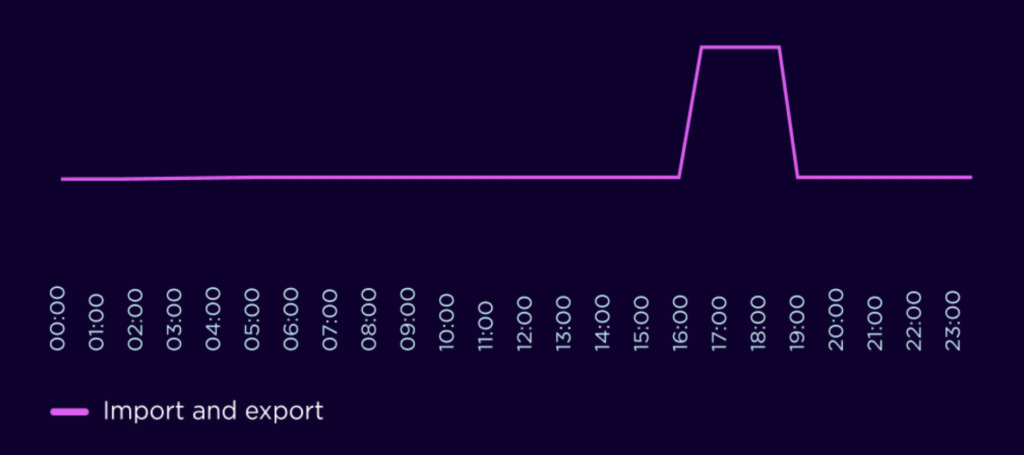
A key feature of Intelligent Octopus Flux is that the import and export rates are exactly the same price within each pricing period.
This means that if electricity costs a certain amount to import during a time window, you are paid the same amount for exporting electricity during that same window.
Peak and off-peak periods
Intelligent Octopus Flux has two main pricing periods: peak and off-peak.
The peak period runs from 4pm to 7pm, when import and export rates are highest. This is the most valuable window for exporting electricity back to the grid, and also the most expensive time to import electricity.
The off-peak period applies outside the peak window, when import and export rates are lower.
The tariff is designed so your battery can help power your home during the peak period, reduce expensive grid imports and export spare electricity when the export rate is higher.
Automatic battery control
Once your compatible battery is connected, Octopus decides when to charge and discharge it.
The system can use a mix of solar generation and grid electricity, depending on your battery level, expected household use, tariff rates and available solar. You do not need to set daily charge and discharge schedules yourself.
Battery behaviour may also change through the year. For example, your home may need more grid charging in winter when solar generation is lower, and less in summer when your panels generate more electricity.
Flexible rates, not fixed rates
Intelligent Octopus Flux rates are flexible, so the actual pence-per-kWh figures can change over time.
The tariff structure stays the same, including the higher-value 4pm to 7pm peak window, but the underlying rates can move. For that reason, it is worth checking the latest Intelligent Octopus Flux tariff rates before switching or comparing it with other solar export options.
Battery compatibility limits
Intelligent Octopus Flux only works with compatible battery systems that Octopus can connect to and control.
If your battery is not supported, the standard Octopus Flux or Agile Outgoing may be the closer alternative because you can use manual battery scheduling instead of automatic optimisation controlled by Octopus.
Who is Intelligent Octopus Flux best for?
Intelligent Octopus Flux is most likely to suit households with solar panels and a compatible home battery that want Octopus to manage battery charging and exporting automatically.
It may work particularly well for:
- Solar and battery homes with a battery system on the Intelligent Octopus Flux compatible list
- Households that want to avoid manually setting charge and discharge schedules
- People who are happy for Octopus to control when the battery charges, holds energy or exports
- Homes with enough battery capacity to store solar generation and export spare electricity during the 4pm to 7pm peak
- Households with meaningful solar generation, where the battery can regularly be charged from the panels
- People who want a smart solar tariff that combines import, export and battery optimisation in one setup
The strongest fit is a home with solar panels, a compatible battery and enough surplus energy to export during the higher-value peak window. If most of your stored electricity is used by the home before 4pm to 7pm, there may be less left to export at the peak rate.
The main thing to check is battery compatibility. Intelligent Octopus Flux is more restrictive than standard Octopus Flux because Octopus needs to connect to and control the battery. If your battery is not supported, standard Octopus Flux may be the closer alternative.
Who should avoid Intelligent Octopus Flux?
Intelligent Octopus Flux is unlikely to suit households that:
- Have solar panels but no home battery, because the tariff requires a compatible battery system
- Have a battery that is not on the Intelligent Octopus Flux compatible list and do not want to change hardware
- Prefer to manually control when their battery charges, discharges or exports
- Want to use a different battery strategy, such as managing export around Agile prices or another time-of-use setup
- Do not want Octopus to control their battery automatically
- Do not want to have their electricity import supply with Octopus
- Have very high electricity use between 4pm and 7pm, leaving less stored energy available to export during the peak window
The main trade-off is control. Intelligent Octopus Flux is designed to optimise a compatible battery automatically, which is useful if you want a hands-off setup. However, it may not suit households that prefer to manage their battery settings themselves.
If your battery is not compatible, standard Octopus Flux may be the closer alternative because it works around manual battery scheduling. If you have solar panels but no battery, an export-only tariff such as Outgoing Octopus is likely to be more relevant.
Homes with heavy 4pm to 7pm usage may still benefit from avoiding peak import rates, but there may be less spare battery energy left to export at the higher peak export rate.
Eligibility
To be eligible for Intelligent Octopus Flux, you will need:
- To be an Octopus Energy electricity customer, or switch to Octopus first
- To have both your import and export tariffs with Octopus
- A solar PV system or another eligible renewable generation system
- A compatible home battery that Octopus can connect to and control
- A compatible smart meter that can send half-hourly readings
- An export MPAN registered for your property
- The relevant installation and grid connection documents, such as an MCS or Flexi-Orb certificate and DNO approval or notification
- The Octopus Energy app on a compatible iPhone or Android phone
Your solar panels and battery do not need to have been installed by Octopus, but your battery must be compatible with Intelligent Octopus Flux. Octopus can usually apply for an export MPAN if you do not already have one.
Compatible Intelligent Octopus Flux batteries
As of June 2026, the Octopus Intelligent Octopus Flux eligibility checker lists the following compatible battery brands:
- AlphaESS
- EcoFlow
- Enphase
- Fox ESS
- GivEnergy
- Hanchu ESS
- Huawei
- Sigenergy
- SolarEdge
- SunPower
- Tesla
Before switching, check the current Octopus compatibility checker using your exact battery brand and model. Do not buy a battery specifically for Intelligent Octopus Flux without confirming that the specific system is supported.
At the moment, Octopus says only one battery can be connected to Intelligent Octopus Flux. If you have a second battery that is not linked with the first, you may need to control that one manually.
How to switch to Intelligent Octopus Flux
If you’re already with Octopus
If you already have your electricity import with Octopus, you can apply for Intelligent Octopus Flux once your solar, battery and smart meter setup is ready.
Your smart meter will need to pass the compatibility check, and your battery must be one Octopus can connect to and control. You will also need your export setup in place, including an export MPAN and the relevant generation documents, such as your MCS or Flexi-Orb certificate and DNO approval or notification.
If you do not yet have an export MPAN, Octopus can usually apply for one on your behalf. The setup can take a few weeks while Octopus checks your documents, creates or transfers the export MPAN and confirms that export readings are being received correctly.
If you’re switching to Octopus
If your electricity import is currently with another supplier, you will normally need to switch your import supply to Octopus first.
New customers are usually placed on Flexible Octopus while the supply transfer and smart meter setup are completed. Once your Octopus account is active, your smart meter is working correctly and your solar and compatible battery setup is confirmed as eligible, you can apply for Intelligent Octopus Flux through the Octopus app.
Find out more about switching to Octopus Energy and receiving £50 credit.
Intelligent Octopus Flux FAQs
Do I need solar panels for Intelligent Octopus Flux?
Yes. Intelligent Octopus Flux is designed for households with solar panels and a compatible home battery.
Your solar panels do not need to have been installed by Octopus, but you will usually need the correct installation and grid connection documents, such as an MCS or Flexi-Orb certificate and DNO approval or notification.
Do I need a battery for Intelligent Octopus Flux?
Yes. A compatible home battery is required.
Octopus needs to be able to connect to and control the battery through the app. If your battery is not compatible, standard Octopus Flux may be the closer alternative, because it is based on manual battery scheduling rather than automatic control.
Which batteries are compatible with Intelligent Octopus Flux?
Battery compatibility can change, so always check Octopus’s current compatibility checker before switching or buying a battery specifically for Intelligent Octopus Flux.
At the time of writing, Octopus says Intelligent Octopus Flux is compatible with GivEnergy, Enphase, SolarEdge and Tesla Powerwall batteries. Compatibility may still depend on the exact model, inverter setup and account connection.
What are the peak hours on Intelligent Octopus Flux?
The peak window runs from 4pm to 7pm every day.
During this period, both import and export rates are at their highest. Outside the peak window, the tariff uses a lower off-peak rate.
Are import and export rates the same on Intelligent Octopus Flux?
Yes. In each pricing period, the import and export rates match.
This means the amount you pay to import electricity and the amount you are paid to export electricity are the same during the same time window. This is one of the main differences between Intelligent Octopus Flux and standard Octopus Flux.
Is Intelligent Octopus Flux fixed or variable?
Intelligent Octopus Flux is a variable tariff, so the actual pence-per-kWh rates can change over time.
The tariff structure stays the same, including the 4pm to 7pm peak window, but the underlying rates can move. Always check the latest Intelligent Octopus Flux tariff rates before switching.
Does Octopus control my battery on Intelligent Octopus Flux?
Yes. Once your battery is connected, Octopus manages charging and discharging automatically.
The aim is to charge your battery when electricity is cheaper or greener, then use or export stored electricity when it is more valuable. You do not need to set manual charge and discharge schedules yourself.
Can I have more than one battery on Intelligent Octopus Flux?
Octopus currently says only one battery can be connected to Intelligent Octopus Flux.
If you have more than one battery, check with Octopus before switching. Compatibility can depend on whether the batteries operate as one linked system or as separate devices.
Is Intelligent Octopus Flux better than Octopus Flux?
It depends on your setup.
Intelligent Octopus Flux may suit you better if your battery is compatible and you want Octopus to manage charging and exporting automatically. Standard Octopus Flux may be better if your battery is not compatible, or if you prefer to control the battery schedule yourself.
The main trade-off is automation versus flexibility. Intelligent Octopus Flux is more hands-off, while standard Flux gives you more manual control.
Can I get Intelligent Octopus Flux if I’m not already an Octopus customer?
Not directly. You need your electricity import and export setup to be with Octopus.
If your electricity supply is currently with another supplier, you would normally need to switch to Octopus first. Once your account, smart meter, solar setup, export MPAN and compatible battery are ready, you can apply for Intelligent Octopus Flux through the Octopus app.
Are there exit fees on Intelligent Octopus Flux?
Intelligent Octopus Flux does not usually have exit fees, but you should always check the current tariff terms before switching.
This is especially important with smart tariffs, because terms, availability and compatibility rules can change over time.
Is Intelligent Octopus Flux always open to new customers?
Not necessarily. Smart tariff availability can change, especially when wholesale energy prices are volatile or Octopus updates tariff terms.
Before planning a switch, check the live Octopus Intelligent Octopus Flux page or the Octopus app to confirm whether new sign-ups are currently open.