

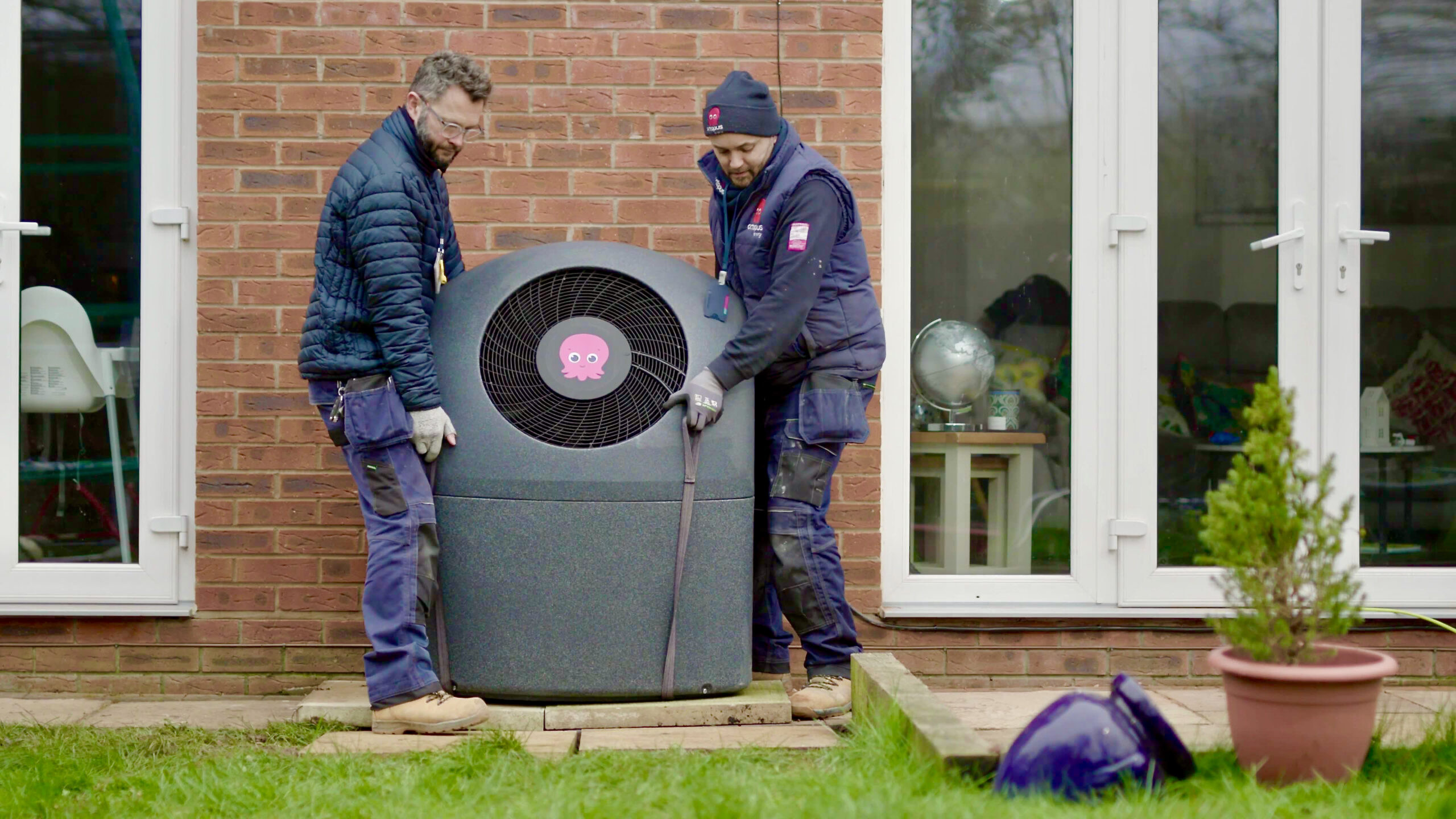
The Boiler Upgrade Scheme is the UK Government’s main grant for replacing fossil fuel heating with a heat pump in England and Wales. It pays £7,500 towards an air source, ground source, or exhaust air heat pump, £2,500 towards an air-to-air heat pump, or £5,000 towards a biomass boiler in eligible rural off-gas properties.
The scheme is administered by Ofgem on behalf of the Department for Energy Security and Net Zero. It runs to 2028. The 2025/26 budget is £295 million.
One thing trips most homeowners up early on. You do not apply for the Boiler Upgrade Scheme yourself. Your MCS-certified installer applies on your behalf and deducts the grant from the quote upfront. Ofgem then pays the installer directly. You pay the net amount.
How much you can get in 2026
| Technology | BUS grant | Key eligibility notes |
|---|---|---|
| Air source heat pump | £7,500 | Most residential properties; replaces fossil fuel or direct electric heating |
| Ground source heat pump | £7,500 | Same as above; requires space for ground array or borehole |
| Exhaust air heat pump | £7,500 | Must be designed to meet full space heating demand |
| Air-to-air heat pump | £2,500 | Domestic properties only; new under April 2026 amendments |
| Biomass boiler | £5,000 | Rural properties only, not connected to the gas grid |
Current as of May 2026. Grant amounts and eligibility are subject to change.
There is also a temporary uplift for oil and LPG households.
| Tier | Grant | Dates |
|---|---|---|
| Standard heat pump grant | £7,500 | Ongoing |
| Temporary uplift (oil and LPG homes, England and Wales) | £9,000 | July 2026 to March 2027 |
The grant is not means-tested. Income, savings, and EPC band do not affect what you can claim.
Who is eligible
The Boiler Upgrade Scheme is for owner-occupiers and private landlords in England and Wales. Scotland has its own [Internal link: Home Energy Scotland Scheme], offering up to £15,000 (a £7,500 grant plus up to £7,500 in interest-free loan). Northern Ireland operates separately again.
To qualify in 2026, you need:
- A property in England or Wales
- An existing fossil fuel heating system (gas, oil, LPG) or direct electric heating without a heat pump
- A valid EPC dated within the last 10 years, OR (from 28 April 2026) alternative evidence such as a recent utility bill and photos of the existing heating system
- An installation no larger than 45kWth
- An MCS-certified installer who is also a member of an approved consumer code
The following are excluded:
- New-build properties (with some self-build exceptions)
- Hybrid systems where a heat pump is retained alongside a gas boiler
- Social housing
- Properties that have already received government grants for a heat pump or biomass boiler
The previous insulation prerequisites were dropped in May 2024. You no longer need loft or cavity wall insulation in place before applying, although your installer may still recommend it to get the system performing well.
What changed in 2026
The April 2026 amendments (SI 2026/390) brought in several changes worth flagging:
- Air-to-air heat pumps are now eligible at £2,500 in domestic properties
- Alternative evidence is allowed where no valid EPC exists
- The grant must be shown as an upfront discount on quotes and invoices
- A temporary £9,000 tier for oil and LPG households runs from July 2026 to March 2027
- The scheme has been extended to 2028
- Exhaust air heat pumps are confirmed eligible at the full £7,500
Further changes are possible. Budgets can also be paused if the scheme is oversubscribed in a given period, so timing matters more than it used to.
How to apply: the installer-led process
The homeowner never deals with Ofgem directly. The process runs like this:
- Find an MCS-certified installer who is also a member of RECC or HIES.
- The installer surveys the property and carries out a [Internal link: Heat Loss Survey Explained].
- You receive a quote with the grant already deducted. The quote must show the gross price, the grant value, and the net amount you pay.
- The installer applies to Ofgem on your behalf.
- Ofgem emails you a consent link to confirm ownership and authorise the work.
- The installer completes the installation.
- Ofgem pays the grant directly to the installer.
You pay only the net figure. The grant never lands in your bank account.
Why MCS certification is non-negotiable
If your installer is not MCS-certified, the grant is legally void. Ofgem will not pay it. This was previously the practical standard. The April 2026 amendments now put it in the regulations directly.
Verify certification yourself. Search the installer on the official MCS register. Do not take their word for it, and do not rely on the certificate logo on their website. A genuine certification can be confirmed in under a minute, and an installer who hesitates when you ask is a red flag.
MCS certification also enforces minimum standards on the heat loss calculation, the system design, and consumer protection. That matters because an oversized or undersized heat pump is the single biggest cause of poor performance complaints.
What the grant does not cover
The £7,500 is a flat figure. It does not scale with the cost of your installation.
Many quotes include radiator upgrades, a new hot water cylinder, pipework changes, and sometimes electrical works. These are part of the installation, not separate items, and the grant comes off the total. What this means in practice is that your out-of-pocket cost depends heavily on the property.
For a typical home, the net cost after the £7,500 grant tends to land somewhere between £2,000 and £8,000. That is a wide range, and it should be a wide range. A small flat with adequately sized existing radiators and a recent cylinder is at one end. A large period property needing new emitters throughout is at the other. See [Internal link: Cost of an Air Source Heat Pump] for a more detailed breakdown.
The Boiler Upgrade Scheme and the Clean Heat Market Mechanism
The Boiler Upgrade Scheme is the consumer-facing side of the picture. Sitting alongside it is the Clean Heat Market Mechanism (CHMM), which came into force in April 2025. The CHMM obliges major boiler manufacturers to match a rising share of their boiler sales with MCS-certified heat pump installations, or pay a buy-out fee per missing installation.
The practical result is that manufacturers now have a direct financial reason to discount their own heat pumps and support installer channels. That is part of why grant-funded heat pump quotes have become more competitive over the last twelve months, and why the headline price you see today is often noticeably lower than it would have been in 2023.
FAQ
How much is the Boiler Upgrade Scheme grant?
In 2026, the grant is £7,500 for an air source, ground source, or exhaust air heat pump. Air-to-air heat pumps get £2,500. Biomass boilers in eligible rural properties get £5,000. From July 2026 to March 2027, oil and LPG households can claim £9,000 instead of £7,500.
Who is eligible for the Boiler Upgrade Scheme?
Owner-occupiers and private landlords of properties in England or Wales currently heated by gas, oil, LPG, or direct electric. The property needs either a valid EPC within the last 10 years or, from 28 April 2026, alternative evidence such as a utility bill and photos. The system cannot exceed 45kWth.
Do I need an EPC to apply?
Usually yes, and it must be within the last 10 years. From 28 April 2026, alternative evidence is permitted where no valid EPC exists. Your installer will tell you what counts.
Is the Boiler Upgrade Scheme means-tested?
No. There is no income test, no savings test, and no EPC band requirement.
How do I apply for the £7,500 heat pump grant?
You do not apply directly. You find an MCS-certified installer who applies to Ofgem on your behalf. The grant is deducted from your quote upfront, and you pay the net amount once the work is done.
Can I get the grant if I live in a new-build?
Not normally. New-builds are excluded. Self-builds may qualify in limited circumstances, and a self-build where a fossil fuel boiler was already installed when you moved in is sometimes treated as eligible. Your installer will assess this.
Does the Boiler Upgrade Scheme cover hybrid heat pumps?
No. Hybrid systems where a heat pump is paired with an existing gas boiler do not qualify. The grant requires full replacement of the fossil fuel system.
When does the Boiler Upgrade Scheme end?
The scheme is currently funded to 2028. It may be extended again, but that is not guaranteed.
What is the £9,000 oil and LPG grant?
A temporary uplift for households in England and Wales currently heated by oil or LPG. The standard £7,500 grant rises to £9,000 between July 2026 and March 2027. After March 2027, it reverts to £7,500 unless extended.
Can landlords claim the Boiler Upgrade Scheme?
Yes. Private landlords are eligible for the same grant tiers as owner-occupiers, provided the property meets the standard eligibility rules.
Is the grant available in Scotland or Northern Ireland?
No. The Boiler Upgrade Scheme covers England and Wales only. Scotland operates the Home Energy Scotland Grant and Loan, offering up to £15,000 (a £7,500 grant plus up to £7,500 in loan). Northern Ireland runs separate schemes through NI Energy Advice.
What happens if my installer is not MCS-certified?
Your application will be rejected and the grant will not be paid. There is no workaround. Verify certification on the official MCS register before signing anything, and treat any installer who claims they can secure the grant “informally” with extreme caution.