

This guide picks apart the best batteries for solar power storage in the UK right now, what actually separates them, and how to match a battery to your household rather than to an installer’s preferred supplier.
If you’re still deciding whether panels themselves make sense, read are solar panels worth it in the UK as a starting point. This article assumes you’ve got panels, or soon will.
Which battery should I buy?
For most UK homes, the strongest all-round choices are the Tesla Powerwall 3, the Fox ESS EP series, Sonnen, and Huawei LUNA 2000. Enphase IQ Battery 5P is also an obvious pick if you want a microinverter setup. Puredrive’s Duracell-branded range is the sensible budget option with a proper UK support structure behind it.
GivEnergy deserves a separate mention. Once one of the most-installed residential batteries in Britain, GivEnergy Ltd entered administration on 9 April 2026. Existing units still work. The manufacturer warranty is gone.
What actually matters when comparing solar batteries
Six things genuinely matter when you’re comparing batteries. Battery size is the obvious one that most people tend to spend more time thinking about. The others get less airtime than they deserve, and a couple of them actually affect the usefulness of the battery more than the size.
Usable capacity, not nominal capacity
A battery advertised as 10 kWh often has only 9.0–9.5 kWh of usable storage. When checking the spec sheet, look for the depth of discharge (DoD). For example, a 10 kWh battery with a 90% DoD provides around 9 kWh of usable energy.
Round-trip efficiency
The percentage of electricity you get back for every unit you put in. Modern LFP batteries sit between 90% and 97%. A few percent doesn’t matter much on one cycle. Over 15 years of daily cycling it adds up.
Continuous and peak power output
Measured in kW, not kWh. This is how much power the battery can deliver at once. If your household regularly pulls 5 kW, a 3 kW battery will top up from the grid rather than cover everything. This matters more than most installers mention, and arguably more than capacity for daily real-world use. A battery with strong output power is often more useful day-to-day than a larger battery with a weaker discharge rate.
Cycle life
Usually quoted as “X thousand cycles at 80% capacity retention.” Anything north of 6,000 is solid. Take headline numbers with some salt.
Warranty
Years covered and throughput (total MWh guaranteed). A 10-year warranty sounds similar across brands, but throughput caps can quietly limit what’s actually covered.
Backup capability
Some batteries can island your home during a power cut. Most need an extra gateway for this. UK power cuts aren’t common for most homes, so don’t overpay unless you need it.
Best home batteries for solar comparison
| Battery | Usable capacity | Approx. installed 2026 | Coupling | Best for |
|---|---|---|---|---|
| Tesla Powerwall 3 | 13.5 kWh | £7,500–£11,000 | Hybrid (DC + AC) | High-power homes, premium pick |
| Fox ESS EP12 | ~11.5 kWh | £6,500–£8,500 | AC or DC | Best value with proper UK support |
| Enphase IQ Battery 5P | 5 kWh per unit | £3,500+ per unit | AC | Existing Enphase microinverter setups |
| Sonnen (10/11 kWh) | ~10–11 kWh | £7,500–£9,500 | AC or DC | Build quality, mature software |
| Huawei LUNA 2000 (10 kWh) | 10 kWh | £5,500–£7,500 | DC (Huawei inverter) | Compact wall space, Huawei systems |
| Puredrive / Duracell Dura5 | ~5 kWh per unit | From ~£4,000 | AC | Budget-conscious with UK support |
A note on the prices above. These are illustrative installed ranges for 2026. Real quotes can land outside these ranges in either direction depending on your existing inverter, electrical work needed, scaffolding, and whether the battery is part of a new solar install or a retrofit. Treat them as midpoints to sanity-check quotes against, not fixed numbers.
Tesla Powerwall 3
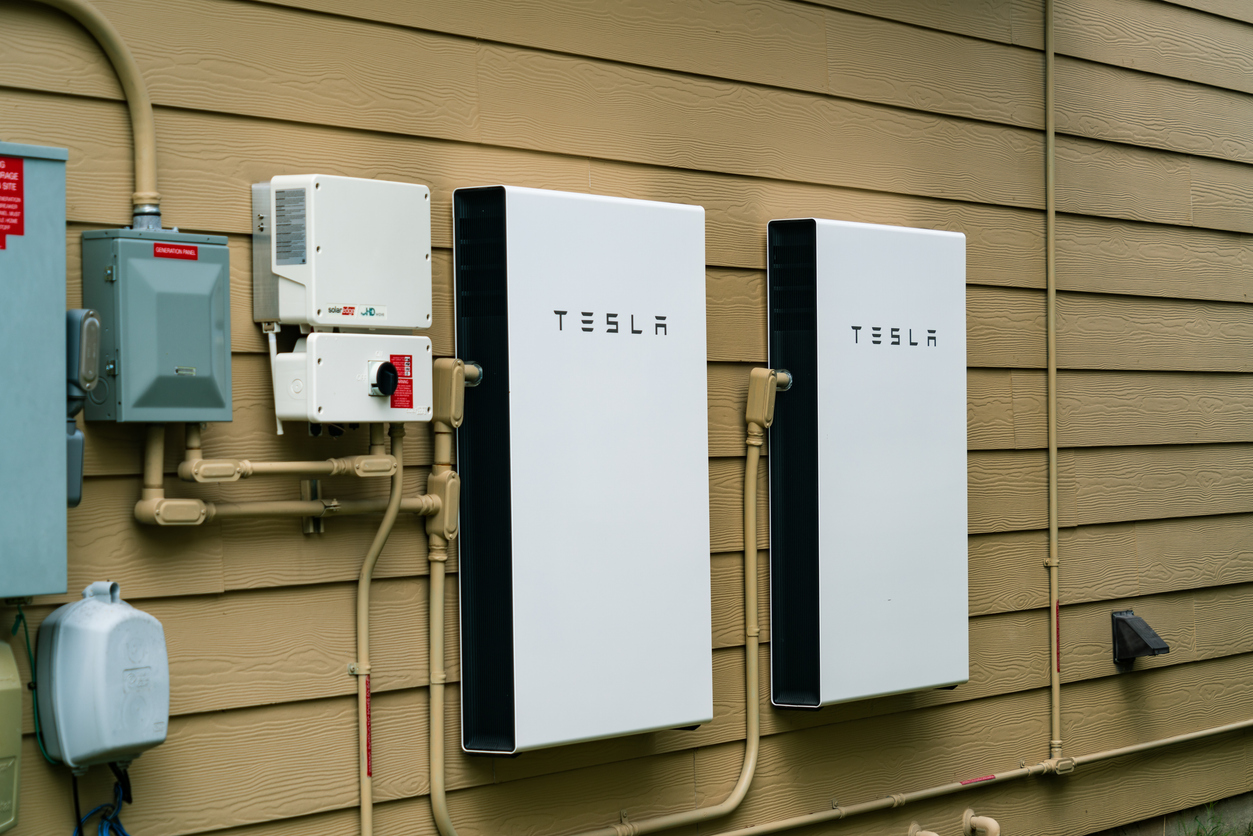
This is the default premium pick. 13.5 kWh nominal capacity, up to 11.04 kW continuous output (class-leading by a wide margin), around 97% round-trip efficiency, and a built-in solar inverter that saves money when installed with new solar. Hybrid coupling means it works for both new installs and retrofits, which is unusual. 10-year warranty with 70% capacity retention at the end. Stackable up to four units.
Typical installed price in 2026 runs around £7,500 (Tesla Powerwall 3) to £11,000 (for a Tesla Powerwall 3 + Expansion Pack).
The downsides. Expansion units are physically large. Adding it to an existing third-party inverter means AC coupling and losing some of the efficiency advantage. Backup adds meaningful cost if you want whole-home islanding. The up-front premium over comparable-capacity rivals is real. If you won’t cycle it hard, the payback maths gets uncomfortable.
Fox ESS EP series
One of the strongest value propositions in the UK market. The EP11 and EP12 offer high voltage storage, 90% depth of discharge, IP65 rating, and modular up to 40+ kWh with the right inverter. 10-year warranty. Round-trip efficiency in the 93–95% range. A single EP12 gives you around 11.5 kWh of usable storage.
Complete Fox systems (inverter plus 10 kWh of storage) typically land around £6,500–£8,000 installed. Fox has a UK service centre and a growing installer network, which matters.
The hardware isn’t as polished as Tesla’s. Plastic casings, slightly utilitarian finish, occasional app grumbles. But it works, it scales, and it’s a few grand cheaper than Powerwall for comparable storage.
Enphase IQ Battery 5P
The obvious pick for an Enphase microinverter solar system. 5 kWh usable capacity per unit, 3.84 kW continuous output, 7.68 kW peak for short bursts, LFP chemistry, AC-coupled. 15-year warranty up to 6,000 cycles. Longest warranty on any mainstream UK battery by a clear margin.
If your panels already use Enphase microinverters, it’s close to a default choice. If they run on a string inverter from a different brand, Enphase rarely makes sense (you’d be duplicating inverter hardware).
Modular. Stack multiple units up to 40 kWh. Indoor or outdoor rated. Typical installed cost starts around £3,500 per unit. Per kWh it isn’t the cheapest, but the warranty length genuinely offsets some of that.
Sonnen
Premium German engineering with a long warranty and a loyal following. The sonnenBatterie 10 is AC-coupled, integrates with most existing solar systems, and comes with a 10-year or 10,000 cycle warranty. LFP chemistry, modular capacity up to around 27.5 kWh in the hybrid range.
Installed prices start around £7,500–£9,500 for an 11 kWh system. Sonnen has been running promotions in 2026, including meaningful discounts on larger capacity models, so shop around.
Worth considering if you value build quality and a mature software platform. Not worth the premium if payback speed is your main concern.
Huawei LUNA 2000
Compact, modular, underrated. 5 kWh battery modules stack into 10 or 15 kWh towers, with parallel configurations up to 30 kWh. 100% depth of discharge advertised, IP66 outdoor rating, 10-year warranty as standard (extendable to 15 on the newer S1). Round-trip efficiency around 95%.
The constraint is ecosystem lock-in. LUNA batteries are DC-coupled and need Huawei SUN2000 inverters. Fine for a new Huawei-based system. Not relevant if you’ve already got a Solis, SolarEdge, or SMA inverter, since you’d need to replace your existing inverter to use it.
Puredrive / Duracell Energy Bank
Puredrive makes the Duracell-branded Dura5, the sensible budget option with real UK support behind it. 5 kWh per unit, modular, fast to fully charge, integrates reasonably well with time-of-use tariffs. Build quality is solid rather than exceptional. Warranty terms are competitive with the mid-market.
Installed costs tend to land below Tesla and Sonnen, and often slightly below Fox ESS for comparable capacity. The ecosystem is narrower, but you’re getting a properly UK-supported product at an accessible price point.
Matching a battery to your household
Capacity is what installers most commonly get wrong, usually by oversizing.
Small home (under 2,500 kWh/year). Flat, small terrace, low-usage couple. You almost certainly don’t need more than 5 kWh of usable storage. Oversizing actively slows payback because you can’t cycle the extra capacity daily.
Average home (2,500–4,500 kWh/year). The UK average sits around 3,500 kWh. Roughly 5–10 kWh is the sweet spot. Fox EP11, a Huawei LUNA at 10 kWh, or a single Powerwall 3 (arguably oversized here).
High-usage home (4,500+ kWh/year). Bigger families, electric cooking, high evening load. 10–15 kWh starts to make sense. Powerwall 3 fits cleanly. Fox EP12 or stacked units equally valid.
Homes with an EV. An EV changes the maths more than the battery itself. Using Intelligent Octopus Go (now with a 6-hour daily limit on smart charging as of 2026) to charge your car at off-peak rates, the same tariff lets you fill a reasonably sized battery overnight. 10 kWh is usually enough.
Homes with a heat pump. Heat pumps push annual electricity use up significantly. Pair with Cosy Octopus (three off-peak windows) and a 10–15 kWh battery. Our best heat pump tariff guide covers Cosy Octopus and the alternatives.
Time-of-use tariff considerations. A battery on a smart tariff can earn or save you meaningfully more than one on a flat rate. Our Octopus SEG tariffs guide goes through Flux, Intelligent Flux and Outgoing in detail. For the wider supplier comparison, our best solar export tariff guide covers everyone else.
AC-coupled vs DC-coupled – which should you get?
DC-coupled batteries share an inverter with your solar panels and skip a conversion step, so they’re a couple of percent more efficient and usually cheaper as part of a new solar system. AC-coupled batteries have their own inverter and retrofit onto almost any existing solar setup. The efficiency difference is real but smaller than it sounds in pounds. On a household cycling 5,000 kWh a year through the battery, two percent is around 100 kWh, or roughly £25 to £30 a year at 2026 prices. Worth noting, but not the main reason to choose one over the other.
New solar plus battery from scratch → DC-coupled (or hybrid) usually wins. Adding to existing solar → AC-coupled is almost always more practical, even if you lose a couple of percent of efficiency.
The Powerwall 3 handles both, which is unusual and genuinely useful.
Installation costs and the 0% VAT situation
Battery retrofit onto existing solar typically runs £4,000–£11,000 fully installed in 2026, depending on brand and capacity. Bundled with new solar, you’re adding roughly £3,500–£9,000 to a solar-only quote.
The 0% VAT rate is still in effect in 2026, covering standalone battery installations, retrofits, and new solar-plus-battery systems. Scheduled to run until 31 March 2027, after which VAT is expected to return to 5%. A genuine saving worth factoring in, but don’t let it rush you into a hurried install.
For the full picture on system costs, our guide to how much do solar panels cost UK has 2026 pricing across the board.
Batteries to be cautious about
The battery market has a long tail of brands you won’t have heard of. Some are fine. Some aren’t.
Suspiciously short warranties, or headline warranty years with throughput caps that quietly limit what’s actually covered. Resold white-label units with unclear manufacturer backing. If your installer can’t tell you who actually makes the cells and the battery management system, that’s a flag.
Installers pushing obscure brands at conspicuously low prices. If every other quote is at £6,000 for 10 kWh and one is at £3,200, ask harder questions. Cheap can mean end-of-line stock from a manufacturer about to exit the UK market, which leaves you with a battery and no support.
Brands with thin UK service networks. If a part fails in year 4 and the nearest service engineer is in Germany, that matters.
The obvious one. GivEnergy going into administration in April 2026 is a reminder that manufacturer stability is a real risk factor, not an abstract one. Even well-regarded UK brands can collapse.
What you can actually do at quote stage
A few practical checks reduce manufacturer risk without paying premium prices.
Ask whether the installer offers their own workmanship and product warranty layered on top of the manufacturer warranty. A 5-year installer warranty backed by a long-trading installer is often more bankable than a 10-year manufacturer warranty from a thinly-capitalised brand.
Ask about insurance-backed warranties. Some manufacturers underwrite their warranty through a third-party insurer, which means the warranty survives the manufacturer collapsing. Worth asking explicitly.
Look up the UK entity on Companies House. Years trading, accounts filed, ownership structure. A two-year-old UK Ltd with one director and minimal accounts is a different proposition from a UK arm of a long-established multinational.
Pay on a credit card if possible. Section 75 protections kick in for purchases over £100, which can recover money on a manufacturer’s failure if the credit card company accepts the claim.
Is a battery worth it at all?
Sometimes yes, sometimes no.
A battery improves self-consumption and lets you arbitrage cheap off-peak electricity against expensive peak electricity. Both are real financial benefits. Typical 2026 savings run anywhere from £300 to £1,200 a year depending on solar size, battery size, tariff choice, and how hard you cycle it.
But. Batteries cost £4,000–£11,000 installed. At the lower end of annual savings, payback can stretch beyond the warranty period. That’s the uncomfortable bit nobody in the sales team wants to say.
Batteries work best when the household will cycle them hard daily, has a smart tariff, has high evening demand, or has an EV or heat pump pushing consumption up. If none of those apply, a battery alone may not pay back in reasonable time. Our complete solar guide covers the wider payback picture properly.
If your primary goal is reducing bills, start with how to reduce your energy bills before spending on hardware.
FAQ
How long do solar batteries last?
Most modern LFP batteries are specified for 10 to 15 years of useful life, with warranties that cover 6,000 to 10,000 cycles or 70–80% capacity retention. Real-world lifespan depends on how hard you cycle them and environmental conditions.
Can I add a battery to existing solar panels?
Yes, almost always. This is retrofitting, usually via an AC-coupled battery that runs alongside your existing inverter. Some hybrid batteries like Powerwall 3 can also work. Your installer will check compatibility.
Do I need a bigger battery if I have an EV?
Not necessarily. If you’re charging the EV on a dedicated off-peak tariff like Intelligent Octopus Go, the car effectively has its own “battery” filled cheaply overnight. The house battery mainly covers non-EV loads. 10 kWh is enough for most EV households.
Are solar batteries safe indoors?
Modern LFP batteries are thermally stable and among the safest battery types, but UK MCS guidance changed in 2022 and battery systems are generally no longer suitable for installation inside main living areas. Most batteries are now installed in garages, utility spaces, or externally. If an installer suggests fitting one indoors without clearly explaining compliance and fire safety, treat it as a major red flag. A good installer should prioritise safety over a quick sale.
Is there VAT on solar batteries in the UK?
Not in 2026. The 0% VAT rate covers standalone batteries, retrofits, and batteries installed as part of a new solar system. In place until 31 March 2027, after which VAT is expected to return to 5%.
What happens if my battery manufacturer goes bust?
The battery keeps working. What you lose is the manufacturer warranty, direct technical support, and potentially future firmware updates. Your installer’s workmanship guarantee and any insurance-backed warranty may still apply. Credit card Section 75 protections may cover recent purchases.
Conclusion
The “best” solar battery depends on your home, your tariff, and your installer.
Tesla Powerwall 3 remains the premium default. Expensive, but it does everything well and has the hardware muscle for high-power homes. Fox ESS is the value play with proper UK support. Enphase is the answer for microinverter systems. Sonnen suits buyers who prioritise build quality. Huawei LUNA is a compact, underrated option for Huawei-based systems. Puredrive’s Duracell range is sensible at the budget end.
GivEnergy was recently one of the strongest recommendations in this market. After April 2026, it isn’t, at least not for new buyers.
Get three quotes. Ask hard questions about warranties and installer track records. Size the battery to your actual usage rather than what maximises the invoice.