

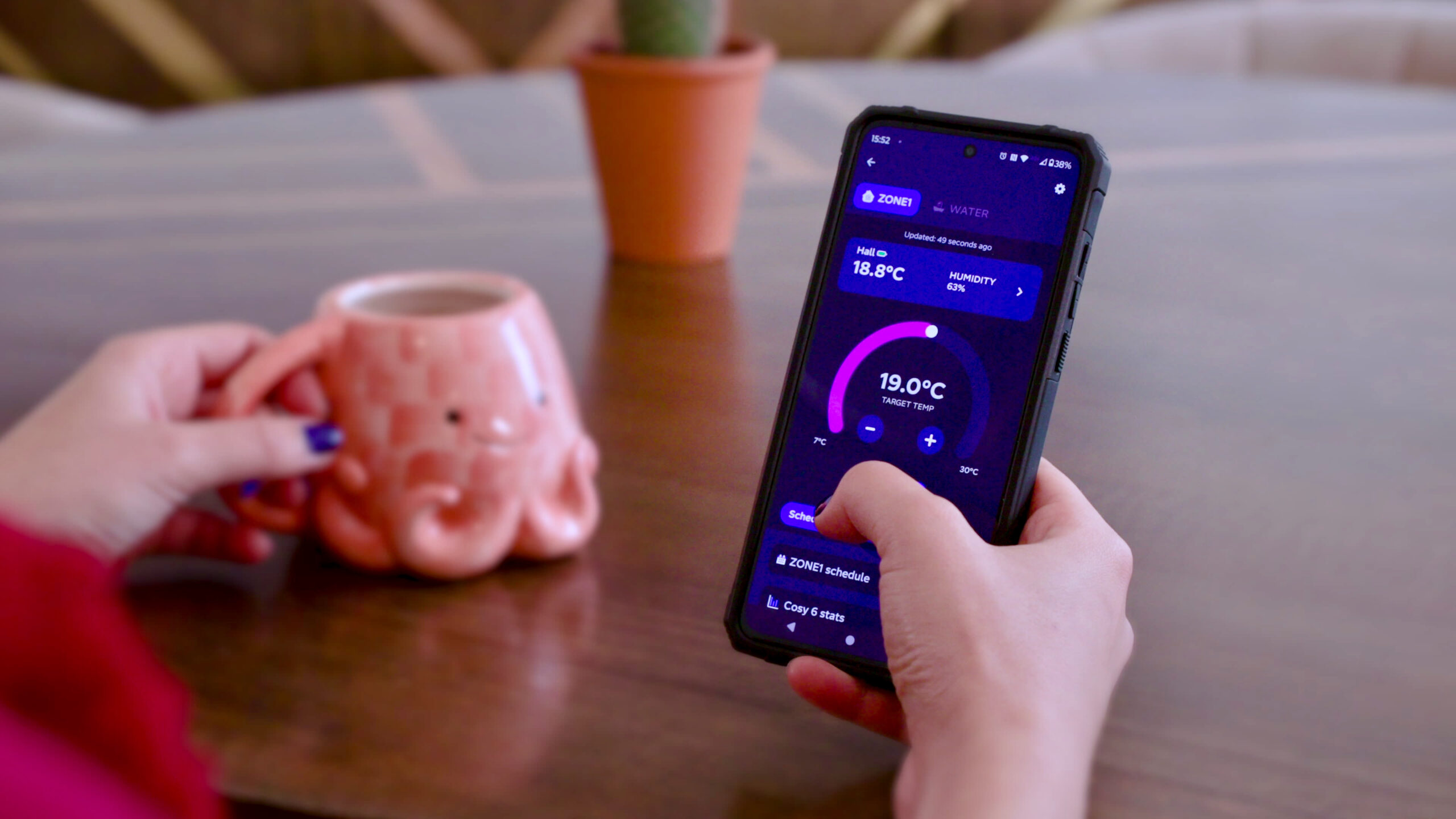
The best heat pump settings to reduce running costs are usually the ones that help your system run steadily at the lowest comfortable flow temperature, rather than switching on and off like a gas boiler. Heat pumps are most efficient when they produce gentle, consistent heat over longer periods.
That means the right setup is not just about turning the thermostat down. Weather compensation, flow temperature, hot water schedules, radiator balance and how long you run the heating can all affect how much electricity your heat pump uses. This guide explains the settings worth checking first, and which changes are most likely to cut costs without making your home feel cold.
Heat pump settings you should change first
The single biggest lever is flow temperature, controlled properly by weather compensation. A 5°C reduction in flow temperature is worth roughly 10% to 12% off your electricity use for heating. Nothing else on the controller comes close.
After flow temperature, the next two wins are scheduling around a heat pump tariff if you’re on one (Octopus Cosy is the obvious example), and getting the hot water cylinder set point and reheat timing right.
Change one thing at a time. Give each change 48 hours to settle before you judge it. Heat pumps are slow systems and the effect of a setting change takes a day or two to show up properly in both comfort and consumption.
Flow temperature: the single biggest setting
Flow temperature is the temperature of the water leaving the heat pump and heading out to the radiators or underfloor pipes. It is not the same thing as room temperature.
The rule of thumb worth memorising: every 1°C of flow temperature costs roughly 2 to 2.5% of your COP. Run a fixed 50°C when you could be running 40°C, and you’re paying 20% to 25% more for the same heat. Over a winter, that’s real money.
What “good” looks like for most well-designed UK installs is a flow temperature in the 35°C to 45°C range at design conditions (the coldest few days of the year), often dropping into the high 20s during mild shoulder seasons. Underfloor systems sit at the lower end. Properly sized radiators can manage the upper end without trouble.
The practical method to find your minimum:
- Drop the flow temperature by 2°C
- Wait 48 hours
- If the house is still warm enough on the coldest day in that window, drop it another 2°C
- Repeat until the house starts to feel a fraction cool, then add 2°C back
Most homes settle somewhere between 38°C and 45°C. Some, with good emitters and good insulation, will settle lower. If you can’t get below 50°C without losing comfort, the system is probably under-emittered (radiators are too small) rather than the heat pump being at fault.
Weather compensation: stop running a fixed flow temperature
Weather compensation is the controller varying flow temperature based on outdoor temperature. At 0°C outside it might run a 45°C flow. At 10°C outside it might run a 30°C flow. The system only runs hot when it actually needs to.
Almost every modern heat pump supports weather compensation. A surprising number are commissioned with it switched off or set to a flat curve. If yours is running a fixed flow temperature year-round, you are leaving substantial efficiency on the table.
The heat curve is what you adjust, not the room thermostat. A steeper curve means hotter flow temperatures in cold weather. A flatter curve means the system stays cooler for longer. The right curve for your home is the one where the house holds its target temperature at every outdoor temperature without you ever needing to override it.
Some systems also offer load compensation, which modulates based on the gap between the room temperature and the set point. Load compensation and weather compensation can work together. Pure room-stat cycling (where the stat just clicks the system on and off) is the least efficient option of the three.
Run continuously, not in bursts
Heat pumps prefer a long, gentle cycle at low flow temperature over a short, hot blast. Turning the system down by 4°C overnight to “save energy” usually costs more, not less, because the system then has to run at a much higher flow temperature in the morning to recover the lost heat. The efficiency loss during recovery wipes out the saving from the setback.
The same applies to TRVs. Closing TRVs in unused rooms forces the rest of the system to fight against itself and pulls the heat pump out of its efficient operating band. Leave radiators open, leave TRVs at 5 or wide open, and let weather compensation do its job.
There is one exception, which is tariff arbitrage.
Scheduling around Octopus Cosy
If you’re on a heat pump tariff with cheap windows, the “always run” rule bends. The goal becomes shifting as much heat into the cheap windows as the building can hold.
Octopus Cosy gives you three off-peak windows totalling eight hours per day: 4am to 7am, 1pm to 4pm, and 10pm to midnight. The peak is 4pm to 7pm, and at current rates it’s roughly three times more expensive per kWh than the off-peak rate. Avoiding heating during peak alone is worth real money.
A reasonable starting schedule for a well-insulated home:
| Time window | Tariff | Heat pump | Hot water |
|---|---|---|---|
| 4am to 7am | Off-peak | Boost set point +1°C | Heat cylinder |
| 7am to 1pm | Day rate | Normal set point | Hold |
| 1pm to 4pm | Off-peak | Boost set point +1°C | Top up if needed |
| 4pm to 7pm | Peak | Setback -1°C or “do not heat” | Off |
| 7pm to 10pm | Day rate | Normal set point | Hold |
| 10pm to midnight | Off-peak | Optional small boost | Off |
The setback during peak is the biggest single saving on this schedule. Well-insulated homes will coast through three hours of “do not heat” without anyone noticing. Leaky homes can’t, and shouldn’t try, because the system will then run flat out at peak rates to recover at 7pm.
Smart heat pump controllers like Homely and Havenwise can do all of this automatically, including adjusting for the weather forecast. More on those below. If you’d rather manage it manually, the built-in scheduler on a modern Daikin, Vaillant, Mitsubishi, NIBE or Viessmann controller is usually capable enough.
Octopus Cosy Tariff has a more detailed breakdown of the windows and pricing.
Hot water cylinder settings
48°C to 50°C is the daily set point sweet spot for most installs. Anything higher pushes the heat pump into much less efficient territory, because hot water demands a higher flow temperature than space heating does. A 60°C set point can drag a heat pump’s COP down to around 2, compared to 4-plus at 35°C space heating.
A weekly Legionella cycle to 60°C or above is required for safety, and is usually scheduled in the small hours when nobody’s using hot water.
Heat the cylinder with the heat pump, not the immersion. The immersion is essentially a three-bar fire in your hot water tank: it runs at 100% efficiency, which sounds good until you remember the heat pump runs at 300%-plus. Heating water with the immersion is roughly three times more expensive than heating it with the heat pump.
If you’re on Cosy, schedule the cylinder reheat to start at 4am so it finishes inside the cheap window. Disable “reheat on demand” where it triggers a top-up the moment someone runs a shower at 5pm. A 200-litre cylinder full of 50°C water has plenty of capacity to coast through the peak.
Common installer-default mistakes worth checking
Things to check on the handover paperwork or in the controller menu:
- Flow temperature set 10°C higher than the design figure on the heat loss survey
- Weather compensation disabled, or set to a flat curve
- Cylinder set point at 55°C or above with reheat on demand
- Buffer tank or low-loss header loops misconfigured (a poorly set up buffer can wreck SCOP by mixing return water back into flow)
- Hysteresis set tight enough to cause short-cycling
- Room thermostat placed somewhere unrepresentative (over a radiator, in a draughty hallway, next to a sunny window)
- TRVs left half-closed across the house
None of this means your installer was lazy. Defaults are often set conservatively for a reason: a homeowner with a cold house in week one will call the installer back, and a homeowner with a slightly higher bill won’t. The defaults that prevent callbacks are the ones that quietly cost you money.
When to leave settings alone
If the system is running well and the bills are roughly in the expected range for the property, don’t fiddle. Most heat pump optimisation videos online are aimed at solving a specific problem, and copying someone else’s settings without that problem will usually make things worse.
A few weeks of monitoring data is worth more than guesswork. The built-in app on a modern unit, an OpenEnergyMonitor setup, or HeatPumpMonitor.org submissions will tell you whether your SCOP is in the 3.5-plus range that a well-tuned air source pump should be hitting, or whether it’s drifting below 3. If it’s the latter, the settings above are where to look. If it’s the former, leave it alone and enjoy the bills.
Smart controllers: are they worth it?
Homely, Havenwise and similar third-party controllers automate weather compensation tuning, tariff-aware scheduling, and predictive pre-heating using the weather forecast. They typically cost £300 to £500 installed and claim 10% to 25% savings over installer-default settings.
The honest take: for homeowners on a heat pump tariff with a complex daily schedule, the payback is usually two to three years. For homeowners on a flat tariff with a well-tuned manual setup, the gains are smaller, often more like 5% to 10%. Native manufacturer apps from Daikin, Vaillant, Mitsubishi, NIBE and Viessmann are improving quickly and may close the gap. If you’re already happy diving into your controller menu and you’re on a flat tariff, a third-party box is probably overkill. If you’re on Cosy and don’t want to think about scheduling, it’s a reasonable buy.
FAQ
What flow temperature should my heat pump run at?
For a well-designed UK install, 35°C to 45°C at design conditions, often dropping lower in mild weather. The exact figure depends on your home’s heat loss and emitter sizing. Lower it in 2°C steps and give each step 48 hours to settle.
Should I leave my heat pump on all the time?
Yes, in most cases. A long, gentle run at low flow temperature is more efficient than short, hot bursts. The main exception is if you’re on a time-of-use tariff like Octopus Cosy, where pre-heating during cheap windows and coasting through peak windows can save more than continuous operation.
What temperature should I set my heat pump to?
Set the room temperature to whatever you actually want to live in (usually 19°C to 21°C) and leave it there. Don’t turn it down at night by more than a degree or two. The savings from setback are smaller than the efficiency loss from recovering afterwards.
Should I use weather compensation on my heat pump?
Almost always yes. A fixed flow temperature means the system runs hot when it doesn’t need to. Weather compensation drops the flow temperature in mild weather, where most of your heating hours actually happen.
What temperature should I set my hot water cylinder to?
48°C to 50°C for daily use, with a weekly Legionella cycle to 60°C or above. Higher daily set points push the heat pump into much less efficient territory.
How do I schedule my heat pump for Octopus Cosy?
Pre-heat during the three cheap windows (4am to 7am, 1pm to 4pm, 10pm to midnight) and set back during the 4pm to 7pm peak if your house holds heat well. Schedule cylinder reheat to land inside the 4am window.
Why is my heat pump short-cycling?
Usually because hysteresis is set too tight, flow temperature is too high for the current heat demand, or there’s a buffer tank or low-loss header misconfigured. Widening the hysteresis and dropping the flow temperature are the first things to try.
Should I turn my heat pump off when I go on holiday?
In cold weather, no. The system has to drag the whole house back up from cold when you return, at a high flow temperature, which is usually more expensive than holding a low set point (around 15°C) while you’re away. In summer it’s fine to turn off space heating and leave hot water on a reduced schedule.
Are smart heat pump controllers worth it?
For homeowners on a heat pump tariff who don’t want to manage scheduling manually, usually yes, with payback in two to three years. For homeowners on a flat tariff with a well-tuned manual setup, the gains are smaller and the case is weaker.
What’s the difference between weather compensation and load compensation?
Weather compensation adjusts flow temperature based on outdoor air temperature. Load compensation adjusts based on the gap between actual and target room temperature. Many modern controllers run both together.
Should I close TRVs in rooms I don’t use?
Generally no. Closed TRVs force the rest of the system to overheat to compensate, which pulls the heat pump out of its efficient band. Leave them open and let weather compensation set the overall flow temperature for the house.
How long does it take to see savings after changing settings?
Comfort changes show up within 48 hours. Bill changes show up within a billing cycle. Give any setting change at least two days before judging it, and don’t change multiple things at once or you won’t know which one moved the needle.