

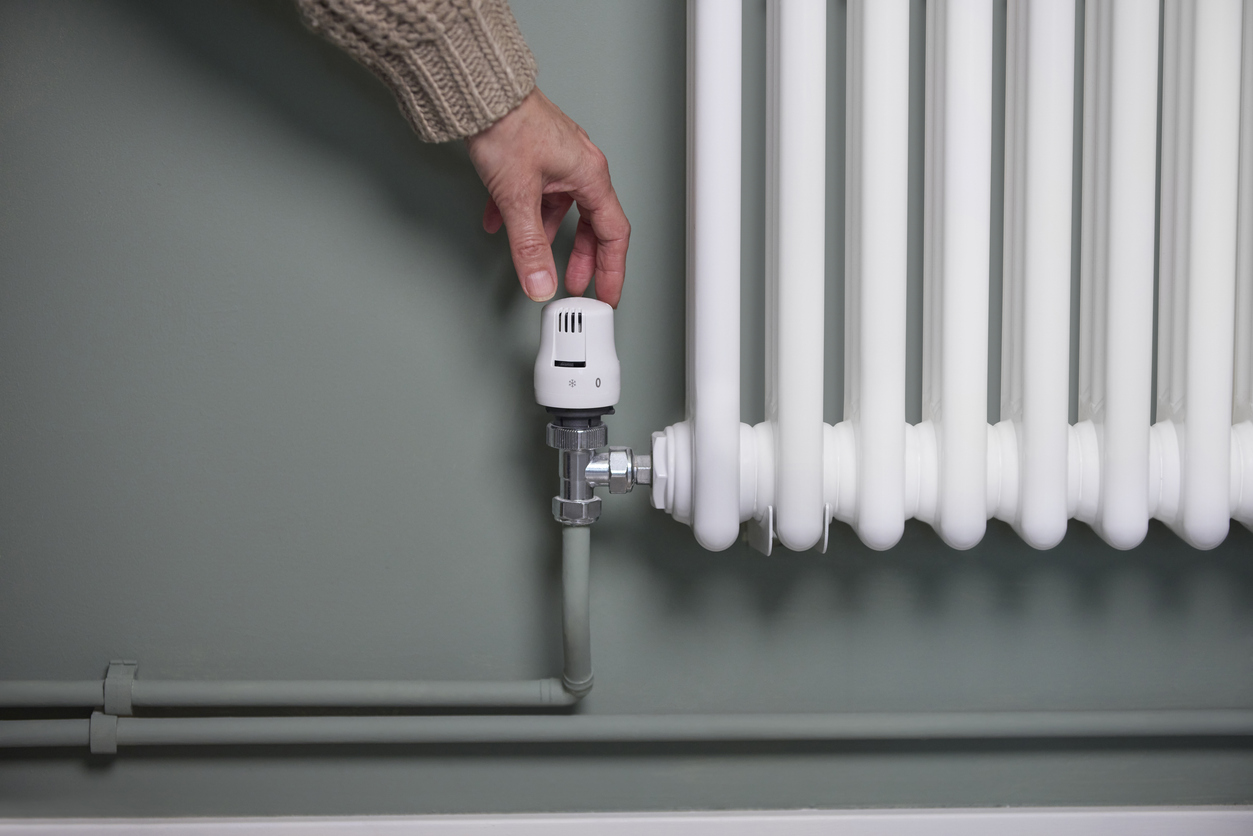
Do heat pumps need new radiators? Probably some of them, but rarely all of them. In a small number of homes, you may not need any bigger radiators at all. Whether your existing radiators will work with a heat pump comes down to one question, asked room by room: can each radiator give out enough heat at the lower flow temperature a heat pump runs at to keep that room warm on a cold winter’s day?
Most UK homes that switch from a gas boiler to a heat pump end up changing a handful of radiators. Often two or three. Sometimes more in older, less insulated properties. Occasionally none. The deciding factor is the maths of surface area, heat loss and flow temperature, not the age of the radiator or whether it has a “heat pump radiator” label on it.
Why heat pumps change the radiator question
Gas boilers in the UK typically run at flow temperatures of around 60–80°C. Heat pumps run most efficiently at roughly 35–55°C. That is the entire reason this question exists.
A radiator’s heat output depends on the difference between the water temperature inside it and the air temperature in the room. Drop the water temperature from 70°C to 45°C and the same radiator emits substantially less heat. For some rooms that drop in output is fine, because the radiator was already oversized for the room’s actual heat loss. For other rooms, it isn’t, and you end up with somewhere that never quite warms up on a cold day.
There are two ways to fix that. The first is to give the room more surface area, either by fitting a physically larger radiator, a deeper one (a double or triple panel convector), or a more efficient type (aluminium, fan-assisted). The second is to run the heat pump at a higher flow temperature so the existing radiators emit more heat. That avoids radiator changes but pushes the heat pump’s efficiency down and your running costs up. It is a trade-off, not a free lunch.
How installers decide which radiators need upgrading
The mechanism is the heat loss survey, sometimes called a room-by-room heat loss calculation. It is a calculation, not an estimate. A proper survey measures every room, accounts for its insulation, glazing, exposure, and target temperature, and works out how much heat the room loses on a cold design day in watts.
Each radiator is then checked against the heat output it would actually deliver at the design flow temperature of the heat pump. Radiators that meet or exceed the room’s heat loss figure stay. Radiators that fall short get specified for an upgrade.
MCS-accredited installers are required to carry out this calculation for any installation receiving the Boiler Upgrade Scheme grant. If a quote arrives without one, that is a red flag. Some installers will quote for more radiator work than is strictly necessary, and some will under-specify to keep the headline price down. The heat loss survey is the document that lets you sanity-check both.
Which radiators are most likely to need changing
Patterns vary, but the radiators most often flagged for an upgrade tend to be:
- Small single-panel radiators in larger rooms.
- Older radiators in rooms with poor insulation or large glazed areas.
- Radiators in heavily used winter rooms, such as living rooms and kitchens, where comfort matters most.
- Radiators that were tightly sized to a 70°C-plus gas system with no spare capacity.
Bedrooms and less-used rooms often stay as they are. Partly because target temperatures are lower (18°C rather than 21°C), partly because existing radiators in those rooms tend to be oversized to begin with. In practice, this is why the cost story for most homes is “some radiators, not all”.
Types of radiator suited to heat pumps
There is no formal “heat pump radiator” category. Any radiator works with a heat pump if it is sized correctly for the design flow temperature. That said, some types are far more often specified than others, simply because they deliver more output per unit of wall space.
| Radiator type | Heat output at low flow temperature | Typical cost (as of November 2026) | Best use case |
|---|---|---|---|
| Single panel | Low | Cheapest | Rarely specified for heat pumps; usually replaced |
| Double panel convector (Type 22) | Good | Mid-range, around £200–£400 fitted | The standard heat pump upgrade |
| Triple panel convector (Type 33) | High | Higher mid-range | Where wall space is limited |
| Aluminium | High, responds quickly | Premium | Faster response, lighter weight, often used in retrofits |
| Fan-assisted | Very high in a compact size | Highest | Tight spaces where a bigger panel won’t fit |
Costs and what to expect
Per-radiator replacement costs in the UK typically sit at around £200–£400 fitted (as of November 2026), with whole-house upgrades usually falling somewhere between £500 and £1,500 depending on how many radiators need changing. Designer aluminium and fan-assisted units sit well above that range.
A few cost points worth flagging:
- Radiator work is usually folded into the installer’s overall heat pump quote rather than priced as a separate line. Ask for it to be itemised.
- Pipework can add cost. Heat pumps move more water at lower temperatures, so existing 8mm or 10mm pipe runs sometimes need upsizing. This shows up on older systems more than on modern ones.
- The Boiler Upgrade Scheme grant of £7,500 (or £9,000 for homes currently on oil or LPG, from summer 2026) applies to the overall installation including any radiator and pipework changes the installer specifies. It is not paid out separately for radiator work.
Underfloor heating, insulation, and the alternatives to changing radiators
Bigger radiators are not the only way to make a heat pump work in a UK home.
Underfloor heating is the ideal emitter for a heat pump. The huge surface area lets it run at very low flow temperatures, often 35–40°C, which is where heat pumps are at their most efficient. Retrofitting underfloor heating through a whole house is rarely cost-effective, but a hybrid retrofit (underfloor in a kitchen extension or new floor build-up, radiators elsewhere) is a fairly common pattern.
Improving insulation first often removes the need for some radiator upgrades altogether. Less heat loss means less heat output required, which means smaller radiators can keep the room warm at lower flow temperatures. Loft insulation, cavity wall insulation, and draught-proofing are usually the cheapest interventions and have a knock-on benefit on running costs whether you fit a heat pump or not.
Running the heat pump hotter to avoid radiator work is an option but a costly one over time. The system will work. The efficiency penalty just compounds with every winter.
FAQ
Do all radiators need replacing for a heat pump?
No. Most UK homes need a handful of radiators upgraded rather than all of them. Some homes need none at all, particularly where insulation is good and existing radiators were generously sized to begin with.
Can I use my existing radiators with a heat pump?
Often, yes, at least for some of them. Whether each individual radiator stays or is upgraded comes down to whether it can deliver the required heat output at the heat pump’s design flow temperature. The heat loss survey is what tells you.
What size radiators do I need for a heat pump?
There is no single answer. It depends on the room’s heat loss (in watts) and the flow temperature the heat pump is designed to run at. As a rough rule of thumb, radiators for heat pumps are often around 1.5 to 2 times the size of equivalent radiators on a 70°C gas system, but the actual figure comes out of the heat loss calculation room by room.
Are there special radiators for heat pumps?
Not really. There is no formal “heat pump radiator” category, despite the marketing. What matters is surface area and heat output at the design flow temperature. Double panel convectors (Type 22), triple panel convectors (Type 33), aluminium and fan-assisted radiators are the types most often specified, simply because they deliver more output per unit of wall space.
Why do heat pumps need bigger radiators?
Because they run at a lower flow temperature than gas boilers, typically 35–55°C against 60–80°C, so each radiator emits less heat at any given moment. More surface area compensates for the lower water temperature.
What is the best type of radiator for a heat pump?
There isn’t a single best type. Double panel convectors are the workhorse choice in most retrofits. Aluminium radiators are popular where weight or response time matters. Fan-assisted radiators are the go-to where wall space is limited but heat output needs to be high. The right pick for any specific room is whatever delivers the required output at the design flow temperature.
How much does it cost to upgrade radiators for a heat pump?
Replacement radiators typically cost around £200–£400 each fitted, with whole-house upgrades often falling in the £500–£1,500 range (as of November 2026). Premium designer or fan-assisted units sit above that. Most installers fold this into the overall heat pump quote rather than billing it separately.
Does the Boiler Upgrade Scheme cover new radiators?
The grant is £7,500 for an air source or ground source heat pump (or £9,000 for homes currently on oil or LPG from summer 2026), applied to the overall installation. Radiator changes specified by an MCS-accredited installer as part of that installation are effectively covered within the overall quote, but the grant is not paid out separately for radiator work.
Will my installer tell me which radiators need changing?
An MCS-accredited installer carrying out a proper heat loss survey will. The survey output should list each room, its heat loss, the existing radiator’s output at the design flow temperature, and a recommendation. If a quote arrives without that detail, ask for it before signing anything.
Can I avoid replacing radiators by improving insulation?
Sometimes, yes. Better insulation reduces a room’s heat loss, which reduces the heat output a radiator needs to deliver. In some homes, addressing loft insulation, cavity walls or draught-proofing first means a borderline radiator stays. In others the saving is real but not enough to keep every radiator unchanged. A heat loss survey done after the insulation work is what tells you which side of the line you land on.