
Octopus Flux is an import and export tariff for homes with solar panels and a battery. This guide covers the latest Octopus Flux tariff rates, how the pricing periods work, who can join and whether the tariff could suit your home.
What are the Octopus Flux tariff rates?
Octopus Flux tariff rates vary by region. Select your area below to see the current import rates, export rates and electricity standing charge available where you live.
What is Octopus Flux?
Octopus Flux is a time-of-use import and export tariff for households with solar panels and a home battery. Instead of giving you one flat import rate and one flat export rate, it splits the day into different pricing periods, with cheaper import rates at some times and higher export rates at others.
The idea is to charge your battery when electricity is cheaper, then use that stored electricity at home or export it back to the grid when export rates are higher. This can work well for solar households that have enough battery capacity to shift electricity around the day.
Octopus Flux is different from Outgoing Fixed and Agile Outgoing because it covers both sides of your electricity account: what you pay to import from the grid and what you are paid to export back to it.
Unlike Intelligent Octopus Flux, Octopus Flux does not control your battery automatically. You need to manage the charging and exporting schedule yourself through your battery or inverter app.
How does Octopus Flux work?
Octopus Flux splits the day into three pricing windows. Each window has its own import rate, which is what you pay for electricity from the grid, and export rate, which is what you are paid for electricity sent back to the grid.
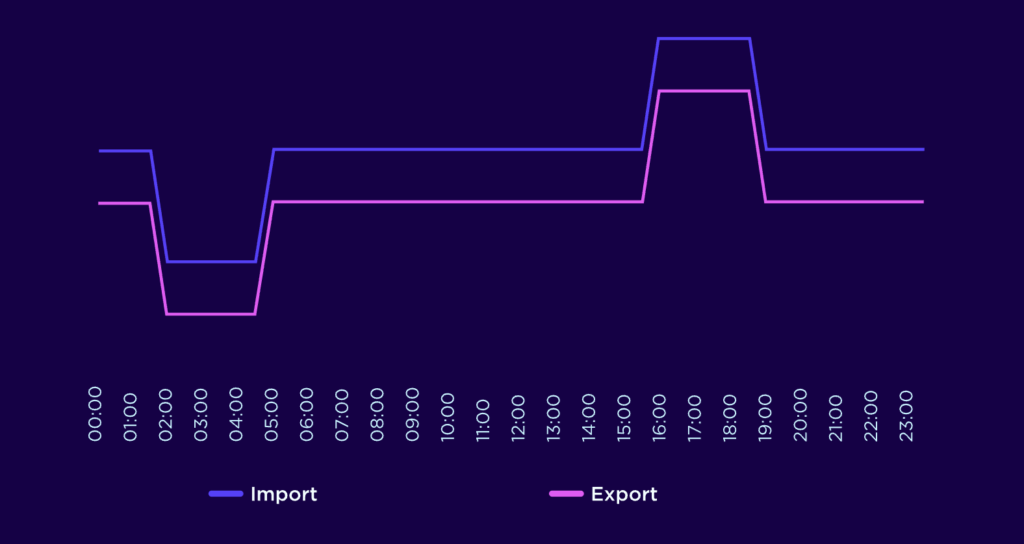
Off-peak: 2am to 5am
This is the cheapest import period and the lowest-paying export period. Most households on Flux use this window to charge their home battery from the grid, ready to use that stored electricity later in the day.
Because the export rate is lower during this window, it usually makes more sense to charge the battery rather than send electricity back to the grid.
Peak: 4pm to 7pm
This is the most expensive import period and the highest-paying export period. The aim is usually to avoid importing electricity during these hours by running your home from the battery instead.
If your battery has spare energy, this can also be the best time to export electricity back to the grid, because the export rate is higher during the peak window.
Day rate: all other times
The remaining hours sit between the off-peak and peak rates. During these periods, solar generation can be used in the home, stored in the battery or exported to the grid if there is surplus electricity.
Manual battery scheduling
The key thing to understand is that standard Octopus Flux does not optimise your battery automatically. You, your installer or your battery app need to set when the battery charges and discharges to take advantage of the fluctuating prices throughout the day and night.
This is different from Intelligent Octopus Flux, where Octopus controls compatible batteries automatically. With standard Flux, the tariff can still work well, but only if your battery is scheduled properly around the off-peak and peak windows.
Who is Octopus Flux best for?
Octopus Flux is most likely to suit households with solar panels and a home battery that can be scheduled around the tariff’s off-peak and peak periods.
It may work particularly well for:
- Solar and battery homes that want time-of-use import and export rates without automated battery control
- Households with a battery that is not compatible with Intelligent Octopus Flux
- People who are comfortable setting charge and discharge windows manually through their battery or inverter app
- Homes with meaningful evening electricity use that can be covered by stored battery energy during the 4pm to 7pm peak
- Households that want a more structured solar export tariff than a basic flat export rate
- People who want more control over battery behaviour rather than handing scheduling to Octopus
The strongest fit is a home that can charge its battery cheaply overnight, use solar generation during the day and avoid importing during the expensive early-evening peak. If the battery can also export spare electricity during the peak window, the tariff may become more valuable.
Who should avoid Octopus Flux?
Octopus Flux is unlikely to suit households that:
- Have solar panels but no home battery, because the tariff relies on being able to shift electricity between cheaper and more expensive periods
- Want a simple flat export payment without managing battery schedules
- Have a battery that cannot be scheduled clearly around the off-peak, day and peak windows
- Have a battery that is compatible with Intelligent Octopus Flux and would prefer Octopus to optimise charging and exporting automatically
- Have low evening electricity demand, meaning there is less benefit from avoiding imports during the 4pm to 7pm peak
- Have a heat pump, EV or other major electricity load where a different import tariff may be more suitable overall
The main issue is flexibility. Flux is built around charging, storing, using and exporting electricity at different times of day. If you do not have a battery, or you do not want to manage when it charges and discharges, a simpler export tariff such as Outgoing Octopus may be easier to use.
If your home has a heat pump, it may also be worth comparing Flux with Cosy Octopus, because heating demand can change which tariff works best overall.
Eligibility
To be eligible for Octopus Flux, you will need:
- To be an Octopus Energy electricity customer, or switch to Octopus first
- A solar PV system or another eligible renewable generation system
- A home battery storage system
- A compatible smart meter that Octopus can communicate with and use for half-hourly billing
- An export MPAN registered for your property
- Octopus to become your registered export supplier
- The relevant installation and grid connection documents, such as an MCS or Flexi-Orb certificate and DNO approval or notification
Your solar panels and battery do not need to have been installed by Octopus. If you do not yet have an export MPAN, Octopus can usually apply for one on your behalf.
How to switch to Octopus Flux
If you’re already with Octopus
If you already have your electricity import with Octopus, you can apply for Octopus Flux once your solar, battery and smart meter setup is ready.
You will usually need a compatible smart meter, a home battery, an export MPAN and the relevant generation documents, such as your MCS or Flexi-Orb certificate and DNO approval or notification.
If you do not yet have an export MPAN, Octopus can usually apply for one on your behalf. The setup can take a few weeks while Octopus checks your documents, creates or transfers the export MPAN and confirms that export readings are being received correctly.
If you’re switching to Octopus
If your electricity import is currently with another supplier, you will normally need to switch your import supply to Octopus first.
New customers are usually placed on Flexible Octopus while the supply transfer and smart meter setup are completed. Once your Octopus account is active, your meter is working correctly and your solar and battery setup is confirmed as eligible, you can apply for Octopus Flux.
Find out more about switching to Octopus Energy and receiving £50 credit.
Octopus Flux FAQs
Do I need solar panels for Octopus Flux?
Yes. Octopus Flux is designed for homes with solar panels and a home battery.
Your solar panels do not need to have been installed by Octopus, but you will usually need the correct installation and grid connection documents, such as an MCS or Flexi-Orb certificate and DNO approval or notification.
Do I need a battery for Octopus Flux?
Yes. Octopus Flux is designed for homes with battery storage.
The tariff works by using different import and export rates across the day, so a battery is what allows you to charge when import rates are lower, avoid importing during the expensive peak period and potentially export when export rates are higher.
Without a battery, a simpler export tariff such as Octopus Outgoing Fixed may be easier to use.
What are the peak and off-peak hours on Octopus Flux?
Octopus Flux uses three pricing windows:
- Off-peak: 2am to 5am
- Peak: 4pm to 7pm
- Day rate: all other times
Both import and export rates follow this same three-window structure, with lower rates overnight and higher rates during the early-evening peak.
Are import and export rates the same on Octopus Flux?
No. Import and export rates follow the same three-window structure, but they are not usually the same figure.
For example, both import and export rates are higher during the 4pm to 7pm peak and lower during the 2am to 5am off-peak period, but the amount you pay to import and the amount you receive for exporting will usually be different.
Is Octopus Flux fixed or variable?
Octopus Flux is a variable tariff, so rates can change over time.
The three daily pricing windows stay the same, but the actual pence-per-kWh rates can move. Check the latest Octopus Flux tariff rates before switching or making decisions based on the tariff.
Does Octopus control my battery on Octopus Flux?
No. Standard Octopus Flux does not control your battery automatically.
You need to schedule charging and discharging yourself through your battery or inverter app. If you want Octopus to optimise a compatible battery automatically, Intelligent Octopus Flux is the tariff designed for that.
Is Octopus Flux better than Intelligent Octopus Flux?
It depends on your battery, your setup and whether you want automated control.
Intelligent Octopus Flux is designed to optimise compatible batteries automatically, while standard Octopus Flux gives you more manual control and may support a wider range of battery systems. If your battery is compatible with Intelligent Octopus Flux and you are happy for Octopus to manage it, that tariff is worth comparing before choosing standard Flux.
Can I get Octopus Flux without being an Octopus customer first?
No. Octopus Flux is an import and export tariff from Octopus, so you need your electricity supply to be with Octopus.
If your electricity import is with another supplier, you would normally need to switch to Octopus first, then apply for Octopus Flux once your account, smart meter, solar and battery setup are ready.
Are there exit fees on Octopus Flux?
Octopus Flux does not usually have exit fees, so you can normally move to another tariff later if your setup or priorities change.
Always check the latest tariff terms before switching, especially if you plan to move between smart tariffs.
Is Octopus Flux still open to new customers?
At the time of writing, Octopus says Flux is temporarily unavailable because energy prices are particularly volatile. Octopus says it will update the Flux page when the tariff becomes available again. Existing customers should check their own account or contact Octopus if they are unsure how this affects them.
Before planning a switch, check the live Octopus Flux page for the current sign-up status. If Flux is not available, solar and battery households may want to compare alternatives such as Intelligent Octopus Flux, Octopus Outgoing Fixed or Octopus Agile Outgoing.