

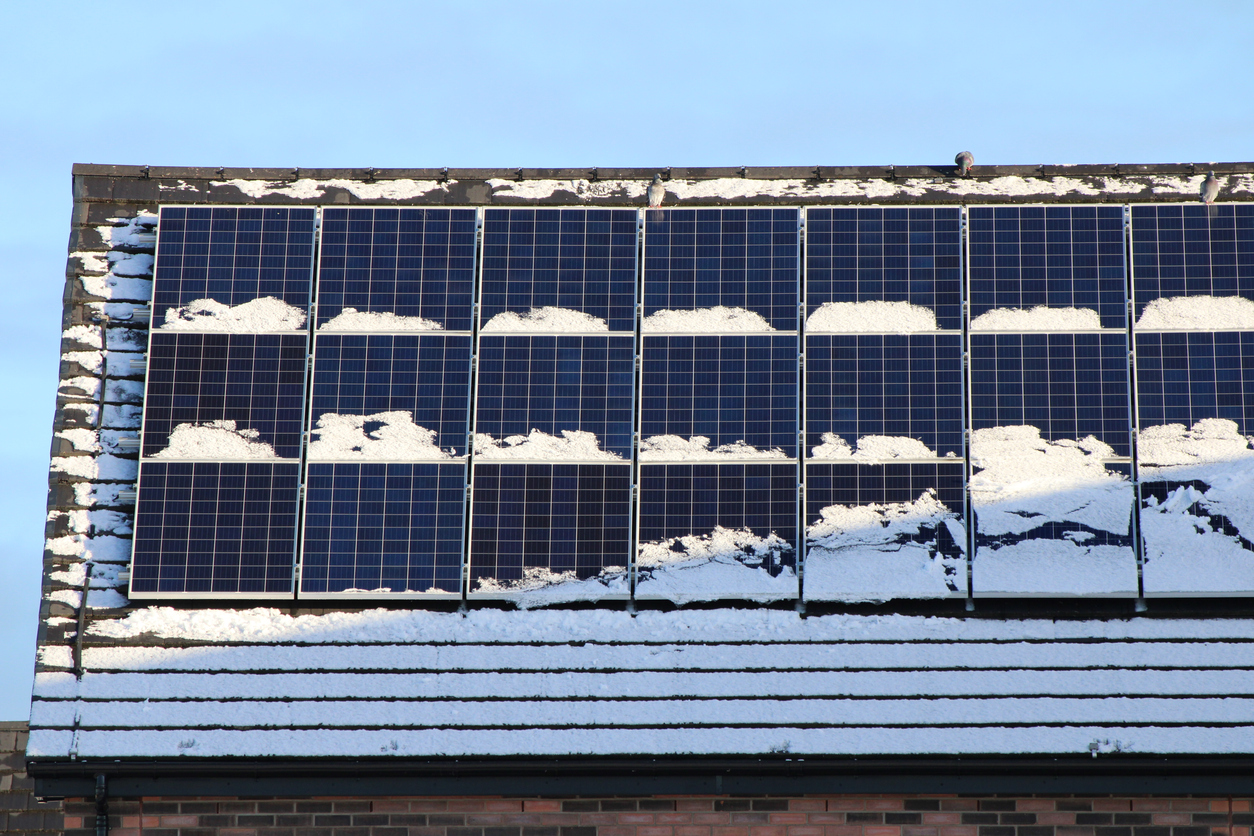
The short answer is yes, solar panels work in winter. They generate electricity from daylight rather than heat, so they keep producing on cold, cloudy, frosty, and even snowy days. Output is lower than in summer, sometimes a lot lower, but a UK solar PV system does not switch off for the colder months.
Winter generation is genuine and useful, just smaller in volume than summer. Annual yield figures from MCS-style estimates already factor this seasonal variation in, so a system quoted at, say, 3,400 kWh a year is not promising even output across all twelve months.
This page walks through how much electricity solar panels actually generate in winter, why output drops, what affects it, and where batteries change the picture.
Why winter output drops (and what it has to do with the cold)
The drop in winter solar generation is entirely about daylight, not temperature. Three factors do the heavy lifting:
Shorter daylight hours. In December the UK gets roughly 7 to 8 hours of usable daylight, against 16 to 17 hours in June. That alone is a step-change in how much energy is available to capture.
Lower sun angle. Even during the daylight that is available, the winter sun sits much lower in the sky. Sunlight has to travel through more of the atmosphere before it reaches the panels, which reduces its intensity.
More frequent cloud cover. UK winters bring heavier and more persistent cloud than summer, scattering sunlight and reducing irradiance further. Panels still produce on overcast days, but at a fraction of clear-sky output.
The cold itself is not the problem. In fact, lower temperatures slightly improve panel efficiency, which is covered further down. The trade-off is straightforward. The efficiency gain from cool conditions cannot make up for the loss of available daylight.
How much electricity do solar panels generate in winter?
For a typical UK domestic system, December and January monthly output usually lands in the region of 20 to 30% of peak summer monthly output. Some systems do worse, some do better, depending on location, orientation, pitch, and shading. The further north you are, the steeper the seasonal swing.
A 4kW system typically generates the bulk of its annual yield between March and October, with November through February contributing a small share. The exact split varies by household, but the broad shape is consistent across the UK. An MCS-style estimate already factors in the winter trough.
Here is a rough seasonal picture for a typical UK system:
| Season | Approximate share of peak monthly output | What is driving it |
|---|---|---|
| Peak summer (Jun-Jul) | Around 100% | Long days, high sun, lowest cloud cover |
| Spring / early autumn (Mar-May, Sep-Oct) | Roughly 50-80% | Reasonable daylight, moderate sun angle |
| Late autumn (Nov) | Roughly 25-40% | Short days, heavier cloud, low sun |
| Mid-winter (Dec-Jan) | Roughly 20-30% | Shortest days, lowest sun angle, frequent cloud |
| Late winter (Feb) | Roughly 30-45% | Daylight returning, sun rising in sky |
These are approximate. A south-facing roof at the right pitch in southern England will sit at the top of these ranges. An east-west split in the north of Scotland with some afternoon shading will sit lower.
What affects winter performance most
A handful of system design choices and site factors do the most to determine how well a system performs through the colder months.
Orientation. South-facing roofs typically win year-round and especially in winter, when the sun never gets high in the sky. East-west splits lose more in winter than in summer because there is simply less light to share between the two sides of the roof.
Pitch. A pitch of around 30 to 40 degrees is generally the sweet spot for UK conditions. Steeper pitches can capture more of the low winter sun, but the gain is usually marginal and shallower roofs do not lose much.
Shading. Low winter sun casts longer shadows. Trees, chimneys, and neighbouring buildings that have no real effect in midsummer can clip a meaningful share of winter output. This is one of the few areas where a site survey is worth taking seriously.
Panel technology. Modern monocrystalline panels handle low and diffuse light better than older or cheaper alternatives. The difference is not dramatic, but on a grey December afternoon it adds up.
Inverter and optimiser design. Where partial shading is a winter issue, microinverters or DC optimisers can help by stopping a shaded panel from dragging down a whole string.
Snow and debris cover. Usually clears itself, given the smooth panel surface and a typical roof pitch. Rarely a long-running problem in most of the UK.
Does cold weather actually help?
Yes, slightly. Solar cells become slightly more efficient as they cool. Electrical resistance drops, voltage holds up better, and the cell converts a higher share of the light hitting it into electricity. Most modern panels carry a temperature coefficient in the region of -0.3% to -0.5% per degree Celsius above 25°C. In practice that means a cold winter day runs the panels closer to their rated efficiency than a hot summer one, when panel surface temperatures can climb well above their test conditions.
It is a real effect. It is also a small one in absolute terms, and it cannot rescue a December day from having a quarter of June’s daylight. The cold helps the panels run well. It does not turn a winter day into a summer one.
Snow, frost, and what to do about them
Light snow rarely causes a significant problem. Panels are smooth, tilted, and dark, so a dusting tends to slide off or melt within a day or two of any sun appearing.
Heavy snow can pause generation while the panels are covered. This usually clears on its own within a couple of days, especially once sunlight starts warming the panel surface. In most of the UK, heavy persistent snow cover is uncommon enough that it does not meaningfully dent annual totals.
Frost has no real effect on the panels themselves. Modern solar PV is built for outdoor conditions and tested across a wide temperature range.
There is also the albedo effect worth mentioning. Light snow on the ground or surrounding roof can reflect additional light onto the panels, occasionally giving a small boost on a bright winter day after a snowfall. Real, but minor in the context of annual yield.
One practical point. Do not climb onto a roof to clear snow off panels. Roof access in winter is genuinely dangerous, and the gain is rarely worth the risk. Waiting for snow to clear naturally is almost always the right call.
Batteries and winter generation
A battery does not increase the amount of electricity your panels generate. What it does is change how much of that generation you actually get to use.
In summer the limiting factor for self-consumption is often the opposite problem. The panels produce more than the house can use during the day, and the surplus exports to the grid. In winter the daily yield is smaller, and most of it lands in the middle of the day. Household demand peaks in the morning and evening, when the panels are barely producing.
A battery stores the limited winter generation and shifts it into the hours when it is actually needed. That lifts the share of winter solar that the household uses directly, rather than exporting at lower export rates. It does not make winter solar look like summer solar, but it does make every kilowatt-hour you produce work harder.
Should winter output put you off solar?
For most UK households, no. The annual yield figures already factor in the winter trough, and the business case for UK solar has never depended on December and January carrying the system. The realistic framing is that solar covers a substantial share of summer demand and a smaller but still useful share of winter demand, with annual savings driven mainly by the longer, brighter half of the year.
A south-facing house with a reasonable pitch and limited shading is unlikely to see the seasonal pattern change the maths meaningfully. Heavy winter shading or a north-facing main roof is worth modelling carefully, but that is a site-specific issue rather than a verdict on UK solar generally.
FAQ
Do solar panels work in winter in the UK?
Yes. Solar PV panels generate electricity from daylight, not heat, so they keep producing through the UK winter. Output is lower because the days are shorter, the sun is lower in the sky, and there is more cloud cover, but the system does not switch off.
How much less electricity do solar panels produce in winter?
For a typical UK system, December and January output usually lands at around 20 to 30% of peak summer monthly output. The exact figure depends on location, orientation, pitch, and shading. November and February sit between this winter trough and the spring and autumn shoulders.
Do solar panels work in cloudy weather?
Yes. Panels capture diffuse light through cloud cover, although at a fraction of clear-sky output. Heavily overcast conditions reduce output significantly, but generation does not stop. Most UK winter days fall somewhere between bright overcast and fully grey.
Do solar panels work when it snows?
If snow is on the ground around the panels but not covering them, yes, and sometimes slightly better than usual due to reflected light. If snow is sitting on the panels themselves, generation pauses until it clears, which usually happens within a day or two.
Does cold weather damage solar panels?
No, not in normal UK conditions. Modern panels are designed to operate across a wide temperature range and tested for cold, wet, and freeze-thaw conditions. UK winter temperatures are nowhere near the limits at which panels would be at risk.
Are solar panels worth it in the UK given the winter?
For most households, yes. Annual yield figures already account for the seasonal drop, and the savings case is driven mainly by spring, summer, and autumn generation. A well-sited system with a reasonable pitch and limited shading typically pays back regardless of the winter trough.
Should I clean snow off my solar panels?
In most cases, no. Roof access in winter is dangerous, and snow usually clears on its own within a day or two. The energy you might recover by clearing it manually is rarely worth the risk.
Do solar panels work at night or in moonlight?
No, not in any practical sense. Moonlight is too weak to drive useful generation, and there is no sunlight at night. Solar generation at night is essentially zero.
How does a battery help with winter solar generation?
A battery stores generation from the middle of the day and releases it during morning and evening peak use. In winter that matters more than usual, because daily generation is small and household demand mostly falls outside the hours when the panels are producing. The battery does not increase generation, but it raises the share you actually use.
Why is my solar output so low in December and January?
Almost certainly because the days are short, the sun is low, and the weather is overcast, not because anything is wrong with the system. A drop to 20 to 30% of peak summer output through midwinter is normal. If output is well below that, or stays low into March and April, check the monitoring app and ask your installer to look at it.