

You’ve decided to get a home EV charger. Now you’re trying to work out which one. Every guide names the same three or four brands in roughly the same order. Ohme. Zappi. Hypervolt. Maybe Easee, maybe Pod Point. All of them are “the best” in someone’s opinion, which doesn’t help much.
The honest answer is that the right charger depends on the household more than the brand. The best home EV chargers UK buyers can pick from in 2026 all do the basics well. What separates them is whether you have solar, whether you plan to live on a tariff like Intelligent Octopus Go, how the unit looks on your wall, and how many EVs you have to charge. By the end of this guide you’ll know which one fits, and what install will cost.
What actually matters when comparing home EV chargers
Six things genuinely separate decent chargers from filler.
Smart tariff integration. A charger with native API integration to your tariff (Intelligent Octopus Go, OVO Charge Anytime) lets the supplier directly schedule and extend your cheap windows. A charger with only a built-in scheduler can hit the standard off-peak block but can’t grab the extra cheap slots Octopus drops in based on grid conditions. Over a year that gap is real money.
Solar diversion. If you have solar, or plan to fit it within the next few years, this matters. A charger with proper solar diversion uses a CT clamp on your meter tails to read surplus export in real time, then pushes only that surplus into the car. Without a CT clamp and dedicated logic, “solar charging” usually just means scheduling the charger to run when it’s daytime.
Tethered vs untethered. Tethered means a fixed cable. Untethered means a socket and you bring your own. Doesn’t change charging speed. More below.
OCPP support. OCPP is the open standard that lets a charger talk to any compatible backend, not just the manufacturer’s app. Most domestic UK chargers are still cloud-locked, which is fine until the brand pivots or charges for a feature that used to be free. Zappi and Easee now ship with OCPP 1.6 as standard. Ohme, Hypervolt and Pod Point still don’t.
Connectivity. Wi-Fi only, or Wi-Fi plus 4G as backup. Sounds minor. It isn’t, if your parking position is at the far end of a 1930s house with thick walls. Ohme and Easee ship with 4G built in.
Warranty and build. Most chargers run 3 years as standard. Andersen goes to 7. The unit sits outside in British weather for a decade, so IP66 + IK10 (Hypervolt) buys real durability in an exposed position. IP54 does not.
You’ll notice “charging speed” isn’t on the list. Deliberate.
The 7.4kW single-phase reality
Almost every UK home is on a single-phase electricity supply. Single-phase physically caps out at around 7.4kW. That’s it. If an installer tries to upsell you a 22kW charger on a single-phase house, the 22kW will still deliver 7.4kW because that’s all your supply can give.
22kW is real, but it requires a three-phase supply, which most homes don’t have and is genuinely expensive to retrofit (often £3,000 to £15,000 depending on what your DNO says). For the rare household that already has three-phase, fine, look at three-phase variants. For everyone else, 7.4kW is the answer and any “fast charging” upsell beyond that is noise.
7.4kW will add roughly 25 to 30 miles of range per hour. An overnight off-peak window comfortably refills a daily commute and most weekend driving.
Ohme Home Pro and Ohme ePod: best for smart tariff savers
If your strategy is built around an EV tariff like Intelligent Octopus Go, Ohme is the default pick.
Ohme was designed around tariff integration. The Home Pro and ePod both have native API connections to Octopus, and the integration is the deepest in the UK market. When Octopus extends your cheap window because the grid needs to absorb overnight wind generation, an Ohme picks that up automatically. A charger on a manual timer stops at 05:30 regardless and you pay peak rate for everything after.
The Home Pro has a small screen, looks slightly industrial, and ships tethered. The ePod is smaller, cheaper, and untethered. Both have 4G built in, useful if your driveway is a Wi-Fi blackspot. Ohme also supports OVO Charge Anytime, so you’re not locked to one supplier.
Honest trade-offs: the Home Pro isn’t the prettiest unit on the wall. No OCPP. No real solar diversion. Warranty is the standard 3 years.
If you’re going to live on an EV tariff and you don’t have solar, this is the one. [Affiliate Link]
MyEnergi Zappi: best for solar households
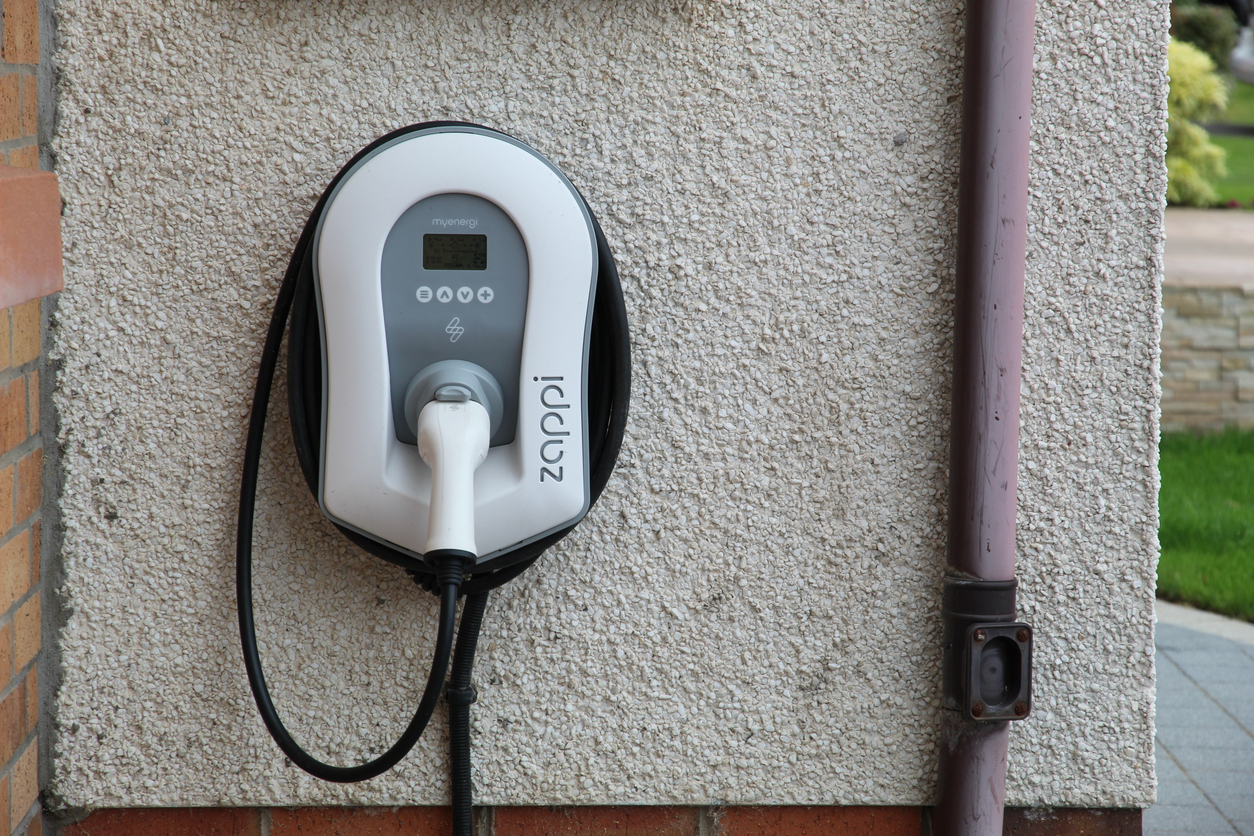
The Zappi is the benchmark for solar diversion and has been for years. Pair it with an Eddi for hot water diversion or a Libbi battery and the whole home energy picture lives in one app.
The Zappi ships with a CT clamp that the installer fits to your meter tails. With it in place, you get three charging modes. Fast ignores solar and pulls from the grid. Eco uses surplus solar but tops up from the grid if there’s not enough. Eco+ only charges when you have genuine surplus, pausing when the sun goes in. That granular control is what nothing else really matches.
For a household with a 4kW south-facing array, that surplus is meaningful. A typical UK year could deliver enough free charging for several thousand miles. Whether you’d otherwise have exported that surplus at the SEG rate is the real comparison: Best Solar Export Tariff covers the maths. Generally, if you drive a fair amount, diverting beats exporting.
The Zappi v2.1 now ships with OCPP 1.6 as standard, a meaningful upgrade. It also works with Intelligent Octopus Go and OVO Charge Anytime for overnight grid charging when there’s no sun. Wi-Fi only. 3-year warranty, extendable to 5.
The case against: if you don’t have solar and aren’t planning to fit it, you’re paying a premium for a feature you won’t use. The Ohme or a basic Pod Point will do everything else for less.
Hypervolt Home 3 Pro: best for design-led buyers and the all-rounder
Hypervolt has built a strong reputation as the polished all-rounder. The Home 3 Pro is UK-designed and built, IP66 and IK10 rated (the toughest in this comparison), and available with 5m, 7.5m or 10m tethered cables. The 10m option matters more than people realise on long driveways or where the consumer unit is at one end of the house and parking at the other.
What changed recently is the tariff side. Hypervolt now supports Intelligent Octopus Go natively through Kraken SmartFlex, alongside OVO Charge Anytime. Until that integration landed, Hypervolt was the prettier charger that lost out to Ohme for IO Go buyers. That gap has closed.
Solar diversion is included via a CT clamp. Hypervolt offers a Super Eco mode that uses surplus generation, though the threshold is slightly higher than the Zappi’s Eco+, so the Zappi still catches smaller surpluses better. For most solar households the difference is small in practice.
Trade-offs: tethered only, Wi-Fi only, no OCPP, premium pricing. The warranty is 3 years through Hypervolt’s trusted installer route and only 1 year if fitted by anyone else, worth flagging at quote stage.
If you want one charger that does everything well and looks good on the wall, this is usually it. [Affiliate Link]
Easee One: best for compact untethered and multi-EV households
The Easee One is by far the smallest and lightest charger you can buy at 1.5kg, comes in five colour covers, and uniquely works as both tethered and untethered from a single unit (the cable locks in via the app).
What sets it apart practically is multi-charger support. You can run up to three Easee One units off a single 32A fuse with built-in dynamic load balancing. For a two-EV household, this avoids the cost of running separate circuits. It ships with integrated Type B RCD and PEN protection, saving £100 to £200 at the consumer unit. Built-in 4G eSIM with lifetime subscription. OCPP 1.6J as standard.
The catch is smart tariff integration. Easee doesn’t have a deep native API link with Octopus. You can schedule charging windows manually to match Octopus Go or Economy 7, and Intelligent Octopus Go is supported but with more setup faff than Ohme or Hypervolt. Solar diversion needs the Easee Equalizer accessory at around £125 extra.
For two-EV households who care about clean design and aren’t married to IO Go, the Easee is excellent. [Affiliate Link]
Wallbox Pulsar Plus / Pulsar Max: the sensible all-rounder
The Wallbox Pulsar is a compact, well-priced, broadly capable unit. OCPP support, decent app, native Alexa and Google Home integration, sensible price. The Pulsar Max is the three-phase variant for the small minority of homes that have it.
It’s the “does most things well, none badly” pick. Smart tariff integration is via schedules rather than deep API. Solar diversion needs a Wallbox accessory. Warranty is shorter than rivals at 2 years standard.
If you don’t have a strong tilt toward solar, tariff or design, and just want a competent smart charger for sensible money, the Pulsar Plus is a fair shout. [Affiliate Link]
Pod Point Solo 3S: best for budget and simplicity
Pod Point is one of the most recognised names in UK EV charging, and the Solo 3S is the unfussy, reliable choice for buyers who want a working smart charger fitted and forgotten about. Solid build, decent app, and now on the Octopus supported device list for Intelligent Octopus Go.
You’re not getting category-leading anything. No OCPP, no native solar diversion, smart features pragmatic rather than impressive. But for a buyer whose top priority is “get it on the wall, get it working, get on with my life”, this is often the right pick. 3-year warranty, OZEV approved. [Affiliate Link]
Andersen A2 / Quartz: best for kerb appeal
If you’re willing to pay a premium for how the charger looks, Andersen is the only name that really matters. The A2 (and newer Quartz) is hand-finished, available in dozens of colours and material finishes including timber and metallic, and is the only charger that hides its cable inside the unit behind a hinged door. Built in the UK.
Smart features are competitive rather than category-leading. The A2 is OZEV-approved and supports Intelligent Octopus Go through Andersen’s Konnect+ app. Warranty is 7 years on most variants, a genuine differentiator in a market where 3 years is standard. The Quartz is newer and cheaper than the A3, though OZEV approval for the Quartz specifically isn’t yet on the published list as of writing. Check with your installer before assuming the grant applies. [Affiliate Link]
Tesla Wall Connector: worth a mention for Tesla owners
Competitively priced direct from Tesla, generous 7.3m cable, and integrates beautifully with Tesla vehicles. For Tesla owners who don’t need smart tariff sophistication, it’s a sensible buy.
Two caveats. It’s not on the OZEV approved chargepoint list, so renters and flat owners cannot claim the grant against it. And it has no UK smart tariff integration in the way Ohme or Hypervolt do. Tesla owners can absolutely fit a Zappi or Ohme instead, and plenty do.
Tethered vs untethered
Tethered means a permanently attached cable. Untethered means a socket and you bring your own. Cable type does not change charging speed.
What it changes is the daily routine. Tethered is faster day to day: grab the gun, plug in, done. Untethered means you fetch your cable from the boot every time. For most single-EV households who plug in every day, tethered wins.
Untethered makes more sense in three cases. Multi-EV homes where the cars take different connectors or where one car came with a long cable already. Households who want a tidy wall when the car isn’t charging. Or chargers in exposed front-garden positions where you don’t want a cable visible all the time.
Cable theft is largely a non-issue: the cable locks electronically at both ends during a session. Storage of the cable in the boot is more of a practical consideration.
Solar diversion explained
A CT clamp is a small ring that clips around your meter tails. It reads the current flowing in or out of the property in real time. With it, the charger can see how much surplus solar you’re exporting, second by second.
Eco mode charges the EV using whatever solar surplus is available, topping up from the grid if generation isn’t enough. Eco+ only charges when there’s genuine surplus, pausing when the sun goes in or the kettle goes on. Eco+ is purer but slower; Eco is faster but pulls some grid power.
In a UK year, a 4kW south-facing array can comfortably divert enough surplus for several thousand miles of driving, depending on home patterns. The economic comparison is against your SEG rate: if you’d otherwise have exported at say 15p/kWh, diverting saves the difference between buying grid electricity and that 15p.
Only a small set of chargers does this properly. Zappi is the benchmark. Hypervolt does it well with Super Eco mode. Indra Smart Pro is in the picture too. Most others can be scheduled to run during daylight but don’t actively follow surplus.
The OZEV grant in 2026
This is the section everyone gets wrong, so worth getting right.
The original Electric Vehicle Homecharge Scheme for owner-occupier homeowners with off-street parking closed in March 2022. If you own your home and have a driveway, you generally cannot claim a grant on a home charger.
What’s still available, and was actually boosted in April 2026:
- EV Chargepoint Grant for renters and flat owners. Up to £500 per socket (raised from £350 on 1 April 2026), covering up to 75% of the installed cost. You need an OZEV-approved installer, an OZEV-approved charger, and written permission from your landlord or freeholder.
- Residential Landlord Chargepoint Grant. £500 per socket, up to 200 sockets per year across your portfolio.
- New on-street parking grant. Launched April 2026, up to £500 per socket, for properties where a cross-pavement solution can be installed safely.
- Workplace Charging Scheme. Up to £500 per socket, up to 40 sockets, for businesses.
All schemes run until 31 March 2027. The government has confirmed this is the final year in current form. For the authoritative current rules, the GOV.UK EV chargepoint grants page is the only source that won’t go out of date underneath you.
If you’re a homeowner with a driveway, the honest message: assume no grant, budget for the full install, and stop reading anyone who tells you otherwise.
Summary comparison
| Charger | Tethered/Untethered | Smart tariff integration | Solar diversion | OCPP | Warranty | Best for |
|---|---|---|---|---|---|---|
| Ohme Home Pro | Tethered | Native (Octopus IG, OVO) | No | No | 3 yr | Smart tariff savers |
| Ohme ePod | Untethered | Native (Octopus IG, OVO) | No | No | 3 yr | Smart tariff, smaller wall |
| MyEnergi Zappi | Both | Native (Octopus IG, OVO) | Yes (Eco/Eco+) | 1.6 | 3 yr | Solar households |
| Hypervolt Home 3 Pro | Tethered | Native (Octopus IG, OVO) | Yes (Super Eco) | No | 3 yr | All-rounder, design |
| Easee One | Both (lockable) | Scheduler / IO Go with setup | Via Equalizer | 1.6J | 3 yr | Multi-EV, untethered |
| Wallbox Pulsar Max | Tethered | Scheduler | Via accessory | Yes | 2 yr | Sensible all-rounder |
| Pod Point Solo 3S | Tethered | Native (Octopus IG) | No | No | 3 yr | Budget and simplicity |
| Andersen A2 / Quartz | Tethered | Native (Octopus IG, OVO) | Optional | No | 7 yr | Kerb appeal |
| Tesla Wall Connector | Tethered | Manual scheduling | No | No | 4 yr | Tesla owners, no grant |
Smart tariff integration noted as “native” only where the brand has a direct API link to the supplier. “Scheduler” means manual scheduling against fixed off-peak windows. Always check the current Octopus and OVO supported-device lists before buying, as the lineup updates.
What it actually costs installed
For a straightforward 7.4kW smart charger fitted by an OZEV-approved electrician, expect to pay £800 to £1,200 fully installed in 2026. That covers the unit, mounting, cable run of around 10 to 15 metres from the consumer unit, electrical testing, commissioning, and Part P certification.
Within that range, budget options (Pod Point, Ohme Home Pro on promotion) sit nearer £800 to £950. Premium options (Andersen, Zappi with solar setup, Hypervolt Home 3 Pro with a 10m cable) sit nearer £1,100 to £1,400.
What pushes it higher: long cable runs beyond the standard 10 to 15m (£15 to £25 per extra metre), consumer unit upgrade if your existing board lacks spare capacity or RCD protection (£400 to £900), trenching across the garden or under the drive (£200 to £500), earthing arrangement requiring an earth rod, or DNO notification and supply upgrade.
The OZEV grant of up to £500 per socket only knocks the price down if you fall into the qualifying categories. It’s capped at 75% or £500, whichever is lower.
Take any quote with a sense check. If it’s £600 fully installed, ask why it’s so low. If it’s £1,800 with a modern consumer unit and a short cable run, ask why it’s so high. Get at least two quotes.
Step-by-step: choosing and installing your charger
- Decide what your charger needs to do. Solar, smart tariff, both, or neither. This pre-selects your brand more than anything else.
- Pick tethered or untethered. Single-EV household plugging in every day: tethered. Multi-EV or strong preference for a tidy wall when not charging: untethered.
- Check tariff compatibility. If you’re planning to switch to Intelligent Octopus Go or OVO Charge Anytime, confirm your shortlisted charger is on the supplier’s current supported device list. The list updates.
- Get at least two quotes from OZEV-approved installers. Cable run length is the biggest cost swing factor, so measure roughly how far the consumer unit is from where you’ll park before asking.
- Check DNO notification requirements. The installer handles this. If you already have a heat pump or solar inverter on site, your supply may already be near its limit and the DNO may need to upgrade your fuse first.
- Confirm OZEV grant eligibility. Owner-occupier with a driveway: no grant. Renter, flat owner, on-street parking, or landlord installing for tenants: probably yes, worth up to £500.
- Book the install and commission via the app. Most installs take 2 to 5 hours on site, though the whole process from quote to fitted can run several weeks.
Common pitfalls
Things people regret six months in:
- Paying for a 22kW charger on a single-phase supply. Your charger will deliver 7.4kW regardless.
- Assuming the OZEV grant still applies as an owner-occupier homeowner. It doesn’t, and hasn’t since March 2022.
- Tethered cable too short. Walk the cable run before ordering.
- Charger that doesn’t talk to the tariff you plan to switch to. Check the supplier’s supported device list, not the charger’s marketing page.
- Ignoring OCPP. Over a 10-year install, getting locked into one brand’s cloud is a real cost.
- Choosing on looks alone for a fully exposed wall. IP44 is fine under a porch. Not in driving rain. IP65 minimum.
Special cases
Renters with off-street parking. OZEV grant still available, up to £500. Written landlord permission required.
Flat owner-occupiers with allocated parking. OZEV grant still applies. Freeholder or managing agent permission usually needed.
Solar households planning a home battery and EV. Orchestration matters more than any single feature. The myenergi ecosystem (Zappi + Libbi) or Hypervolt + GivEnergy / Tesla Powerwall in parallel apps are the strongest paths.
Multi-EV households. Easee’s multi-unit load balancing on a single fuse is genuinely useful. Otherwise an Ohme ePod per car is a tidy option for tariff-led households.
Households with no off-street parking. A new on-street grant launched in April 2026 for properties where a cross-pavement solution is viable. See EV Charging at Home Without a Driveway.
Households planning to move within 2 to 3 years. A premium charger stays on the wall when you leave. Some sellers price it in; many don’t. A £900 Ohme is usually a better bet than a £1,500 Andersen if you’re not staying.
FAQ
What’s the best home EV charger in the UK in 2026?
There isn’t one. For Intelligent Octopus Go buyers, the Ohme Home Pro is usually the answer. For solar households, the Zappi. For a polished all-rounder, the Hypervolt Home 3 Pro. For multi-EV homes, the Easee One. For budget, the Pod Point Solo 3S. The right answer is the one that matches the household, not the brand.
Do I need a smart EV charger?
Effectively yes. Smart Charge Point Regulations 2021 require all new home chargers sold in the UK to have smart features by default. The real question is how deep that integration goes, which is what most of this guide is about.
Is Zappi better than Ohme?
Different jobs. Zappi is the answer if you have solar. Ohme is the answer if your savings strategy is built around an EV tariff like Intelligent Octopus Go. If you have both solar and a tariff, the Zappi covers both reasonably well; the Ohme doesn’t really do solar.
Can I still get the OZEV grant as a homeowner?
If you own a house with a driveway, no. That scheme ended in March 2022. The current grants cover renters, flat owners, landlords installing for tenants, and (from April 2026) households with on-street parking only.
What’s the difference between tethered and untethered?
Tethered has a fixed cable, faster day to day. Untethered is a socket, requires you to bring your own cable, but suits multi-EV households and tidier walls.
How much does it cost to install a home EV charger?
Typically £800 to £1,200 fully installed in 2026 for a straightforward job. Long cable runs, consumer unit upgrades and groundworks push it higher.
Do I need 22kW charging at home?
Almost certainly not. 22kW needs three-phase supply, which most UK homes don’t have. On single-phase you cap at 7.4kW regardless of charger.
Will my home EV charger work with Intelligent Octopus Go?
Native API integration (best experience): Ohme Home Pro, Ohme ePod, Hypervolt Home 3 Pro, MyEnergi Zappi, Pod Point Solo 3S, Andersen A2/A3, Indra Smart Pro. Manual scheduling or with setup faff: Easee One, Wallbox, Tesla Wall Connector. The Octopus supported device list is the authoritative source and updates from time to time, so check it before buying.
Wrap-up
If you have solar, the Zappi is almost always the right answer, and the case gets stronger the bigger your array. If you’re going to live on Intelligent Octopus Go or OVO Charge Anytime, the Ohme Home Pro (or ePod if you want untethered) is the default. For a polished all-rounder, the Hypervolt Home 3 Pro is hard to beat in 2026 now the Octopus integration has landed. For two-EV homes, the Easee One. For budget buyers, the Pod Point Solo 3S. For buyers who care most about looks, the Andersen A2 or Quartz.
Most of the running-cost savings come from the tariff, not the charger. Once it’s on the wall, the next decision is what to plug into. See Best EV Tariffs UK, or the EV Home Charging Guide for the bigger picture.
Brand lineups, supplier integrations and grant rules all change. Double-check the current Octopus supported device list, the GOV.UK grants page, and the warranty on whatever you actually buy before pulling the trigger.